
Stop Treating VIP Customers Like Cart Abandoners: The Intelligent Segmentation Framework
Picture this: Your best customer who's spent $5,000 this year gets the same "Come back! Here's 20% off!" email as someone who abandoned a $15 cart six months ago. Sounds ridiculous, right? Yet this exact scenario plays out in thousands of businesses every day.
The problem isn't just that it's ineffective, it's actually damaging your most valuable relationships while wasting money on the wrong customers. When you treat VIPs like cart abandoners, you're essentially telling your most loyal customers that they're no more important than someone who couldn't commit to a purchase.
Let's fix this with an intelligent segmentation framework that actually makes sense.
Why VIP Customers Aren't Just "High-Value Cart Abandoners"
VIP customers and cart abandoners exist in completely different universes when it comes to their relationship with your brand. Cart abandoners are stuck in the consideration phase, they're uncertain, price-sensitive, and need convincing. VIPs have already moved far beyond that. They're committed, they trust your brand, and they've proven their loyalty with their wallets.
When you send a VIP customer the same discount-heavy recovery email you'd send to a cart abandoner, you're actually devaluing their loyalty. Think about it: Why would someone who regularly pays full price want to see that you're offering steep discounts to everyone else?
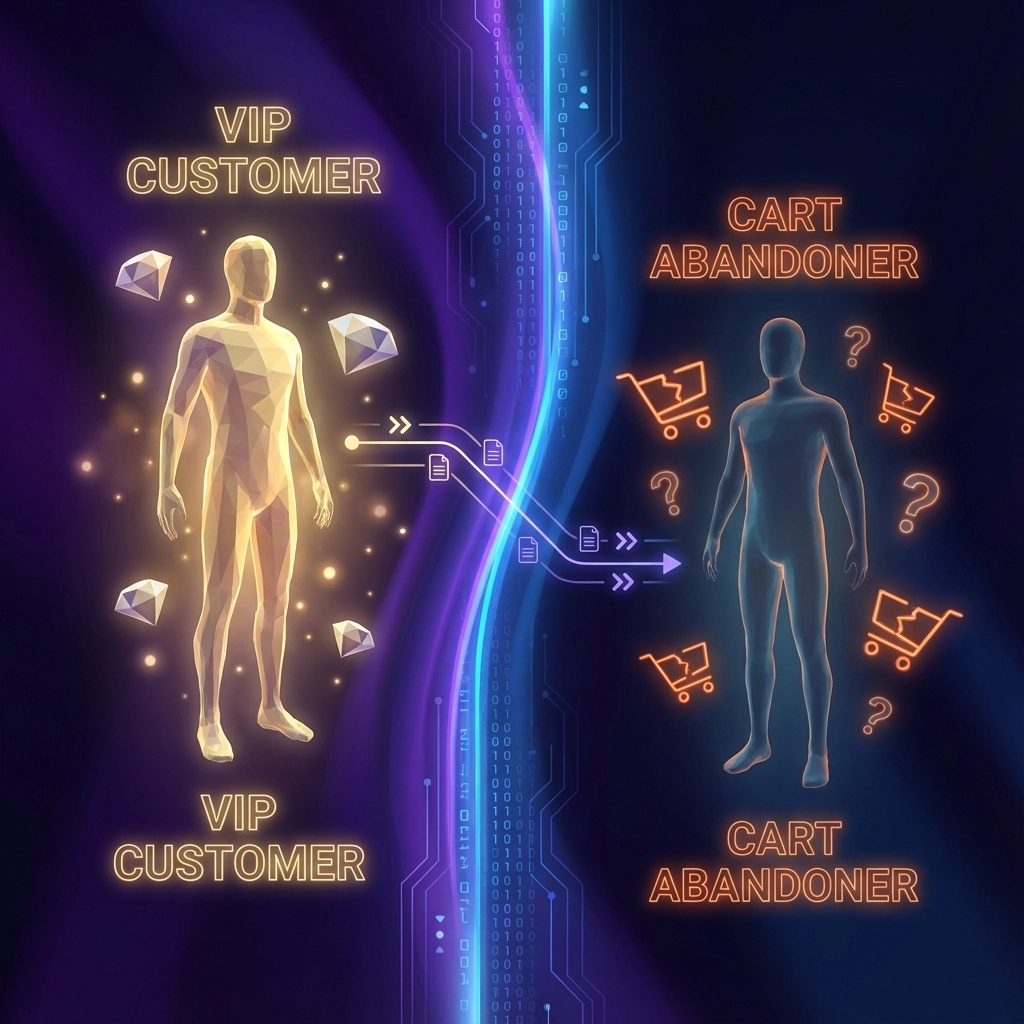
The psychology is completely different too. Cart abandoners need friction reduction and incentives to complete their purchase. VIPs need recognition, exclusivity, and premium experiences that acknowledge their status.
The Three-Pillar VIP Identification System
Before you can segment intelligently, you need to know who your VIPs actually are. Most businesses get this wrong by using arbitrary thresholds or gut feelings. Here's the data-driven approach:
Pillar 1: Big Spenders
These customers have crossed a significant revenue threshold in a defined timeframe. For most e-commerce businesses, this might be customers who've spent $2,000+ in the last 12 months. But your threshold should be based on your actual customer data, not industry averages.
Pillar 2: Frequent Purchasers
Sometimes loyalty matters more than total spend. A customer who buys $200 worth of products every month is more valuable than someone who made one $2,400 purchase and disappeared. These customers show consistent engagement and predictable revenue.
Pillar 3: Blended Approach
The smartest segmentation combines both metrics. A customer qualifies as VIP if they meet EITHER your spending threshold OR your frequency threshold. This captures different types of valuable customers, the high-spender and the loyal repeat customer.
Most successful businesses find that about 20% of their customer base falls into the VIP category using this blended approach. If you want to get more exclusive, you can create tiered VIP segments (top 1%, next 4%, etc.) for even more personalized treatment.
Building Your Intelligent Segmentation Framework
Step 1: Define Your Core Attributes
Your segmentation should examine four key dimensions:
Recency: How recently did they purchase? VIPs typically have recent activity.
Frequency: How often do they buy within specific timeframes?
Monetary Value: What's their total contribution to your revenue?
Behavioral Patterns: What products do they prefer? How do they engage with your content?
Step 2: Choose Fixed vs. Dynamic Thresholds
This is where most businesses mess up. Fixed thresholds (like "$2,000+ annual spend") are easy but inflexible. Dynamic thresholds that recalculate regularly are more sophisticated.
With dynamic segmentation, you might recalculate VIP status daily, but include grace periods so customers don't get demoted the moment they drop below a threshold. This prevents good customers from being wrongly downgraded due to natural purchase cycles.

Step 3: Set Smart Recalculation Frequency
Daily recalculation keeps your segments current, but you need grace periods. A VIP customer shouldn't lose their status just because they haven't purchased in 30 days, they might have a 45-day purchase cycle.
Step 4: Track Customer Potential
Here's an advanced move: track each customer's highest achieved tier, even if they've dropped. A customer currently in Tier 3 who was previously Tier 1 represents massive recovery potential and should be treated differently than someone who's always been Tier 3.
What VIP Treatment Actually Looks Like
Forget the discount-heavy approach you'd use for cart abandoners. VIP customers need premium engagement:
Exclusive Early Access: Give them first dibs on new products, sales, or limited editions before anyone else knows about them.
Customization Opportunities: Let them create their own bundles, choose their own rewards, or influence product development through surveys.
Recognition and Status: Feature them on social media, invite them to exclusive events, or give them special status badges or tiers.
Premium Support: Dedicated customer service lines, faster shipping options, or personal account managers.
Insider Information: Behind-the-scenes content, founder stories, or sneak peeks at upcoming launches.

The key is making them feel special, not just offering them better deals. They already buy from you: they need reasons to feel proud about that choice.
The Cart Abandoner Strategy (Keep It Separate)
Meanwhile, your cart abandoners need a completely different approach focused on conversion optimization:
- Gentle reminders about forgotten items
- Limited-time discount incentives
- Social proof and urgency elements
- Simplified checkout processes
- Payment plan options for high-ticket items
These tactics work for cart abandoners because they address specific friction points in the purchase process. Using them on VIPs suggests they have the same relationship hesitations, which is insulting.
Implementation: Your 30-Day Segmentation Overhaul
Week 1: Audit your current segmentation. Export your customer data and analyze spending patterns, purchase frequency, and behavioral metrics. Identify your current "accidental VIPs" who are getting generic treatment.
Week 2: Build your VIP criteria using the three-pillar system. Test different thresholds against your historical data to find the sweet spot where about 15-25% of customers qualify as VIP.
Week 3: Create separate campaign tracks. Design VIP-specific email sequences, offer structures, and engagement strategies that focus on exclusivity rather than discounts.
Week 4: Implement dynamic recalculation with grace periods. Set up automated workflows that move customers between segments based on their behavior while protecting against rapid demotions.
The ROI of Getting This Right
When you properly segment VIPs from cart abandoners, you typically see:
- 25-40% increase in VIP customer lifetime value
- 15-20% reduction in VIP churn rates
- 30-50% improvement in email engagement rates for VIP segments
- Significant cost savings from not discounting to customers who don't need incentives

More importantly, you build stronger relationships with your most valuable customers instead of accidentally training them to wait for discounts.
Common Segmentation Mistakes to Avoid
The "One-Size-Fits-All" Trap: Using the same messaging, offers, and timing across all customer segments.
The "Discount Everything" Mistake: Assuming all customers are price-motivated when VIPs often value exclusivity over savings.
The "Set It and Forget It" Error: Building segments once and never updating criteria or strategies based on performance data.
The "Too Many Tiers" Problem: Creating so many micro-segments that you can't effectively manage different strategies for each.
Your Next Steps
Start by auditing your current customer communication. Look at the last 10 emails you sent to customers: how many were differentiated based on customer value? If the answer is "none" or "very few," you're leaving serious money on the table.
Remember, behavioral AI and intelligent segmentation aren't just buzzwords: they're essential tools for maximizing customer lifetime value in 2026 and beyond.
The businesses that get this right don't just see better metrics: they build stronger, more profitable relationships with the customers who matter most.
Keywords: intelligent segmentation, behavioral ai, customer retention strategies, retention optimization, ai behavioral analysis, profit optimization