
Behavioral AI vs Traditional Segmentation: Which Drives Better ROI in 2026?
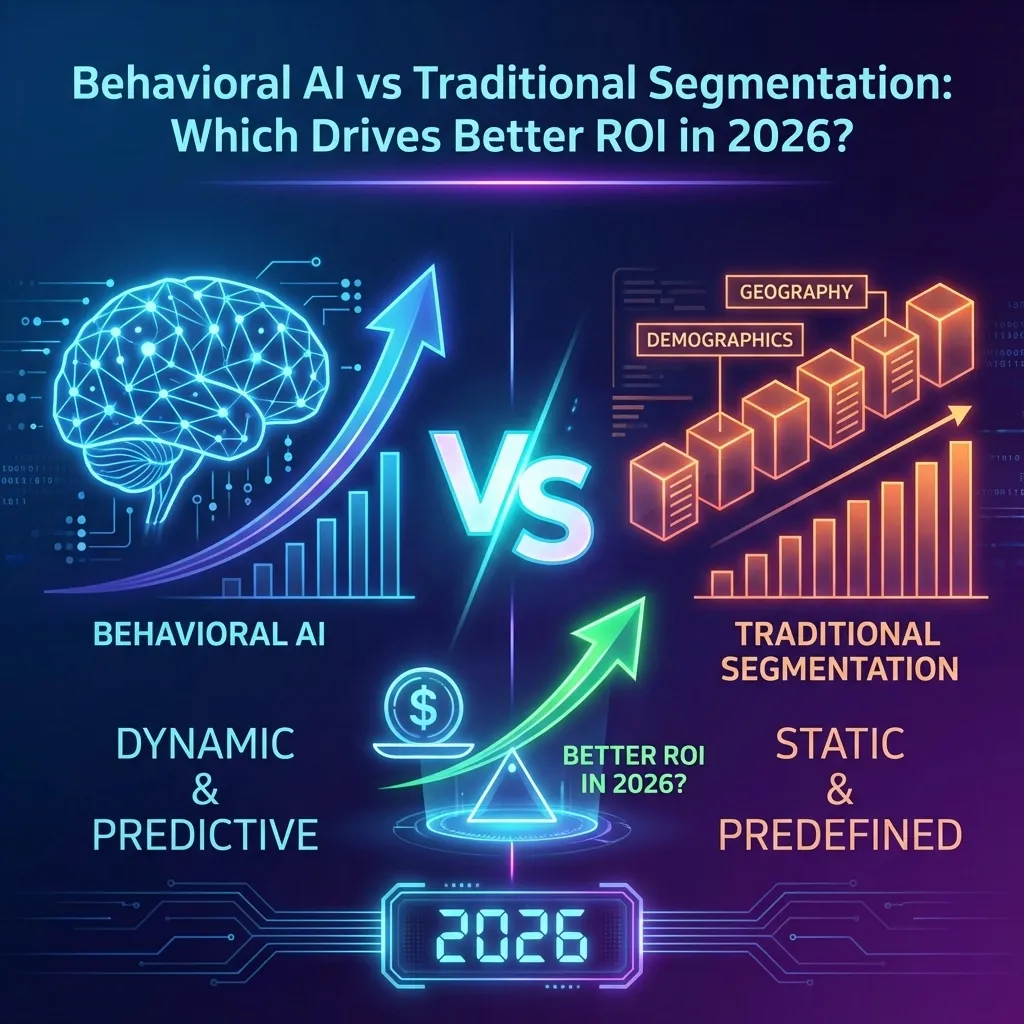
The data is crystal clear: behavioral AI segmentation delivers 40% higher ROI on paid campaigns and 32% increases in repeat purchases compared to traditional demographic targeting. Yet most brands are still burning budgets on outdated segmentation methods that treat a 25-year-old software engineer the same as a 25-year-old barista simply because they share an age bracket.
2026 marks the definitive turning point where behavioral AI isn't just an advantage: it's table stakes for competitive survival. Organizations clinging to traditional segmentation are hemorrhaging profits to competitors who understand that how customers behave matters infinitely more than who they are on paper.
The Traditional Segmentation Death Spiral
Traditional segmentation relies on static demographic attributes: age, gender, location, income level. Marketing teams manually create broad buckets and blast generic campaigns to each group, hoping something sticks. The fundamental flaw? Demographics tell you nothing about purchase intent.
A 35-year-old executive earning $150K might never convert, while a 22-year-old student could become your highest lifetime value customer. Traditional segmentation misses these nuances entirely, leading to:
- Massive budget waste on unqualified prospects who fit demographic profiles
- Missed revenue opportunities from high-intent customers in "wrong" segments
- Generic messaging that fails to address actual customer motivations
- Static segments that become obsolete as customer behavior evolves
The rising cost of customer acquisition makes these inefficiencies lethal. Brands using traditional segmentation are paying premium prices for mediocre results while competitors leverage behavioral AI to identify and convert customers at a fraction of the cost.

How Behavioral AI Segmentation Actually Works
Behavioral AI abandons demographics entirely in favor of action-based intelligence. Instead of grouping customers by age or location, advanced algorithms analyze real-time behavioral signals:
- Browsing patterns and session depth across touchpoints
- Purchase history and buying frequency indicators
- Engagement sequences with content and campaigns
- Intent signals like search behavior and time spent on key pages
- Interaction timing and channel preferences
Machine learning continuously clusters customers based on these behavioral signatures, automatically shifting segments as customer actions evolve. The result? Micro-segments of 50-500 customers who share identical behavioral patterns rather than generic demographics.
A behavioral AI system might identify that customers who view product pages for 3+ minutes, return within 48 hours, and engage with email content have an 87% likelihood of purchasing within 14 days: regardless of their age, gender, or location. This precision enables surgical targeting that traditional methods could never achieve.
The ROI Performance Gap is Staggering
Organizations implementing behavioral AI segmentation report conversion uplifts between 40-200% compared to traditional demographic targeting. The performance advantages compound across multiple metrics:
Campaign Performance
- 40% higher ROI on paid advertising campaigns
- 25% reduction in customer acquisition costs
- Revenue per visitor increases up to 38%
Customer Retention
- 32% increase in repeat purchase rates
- 20-30% higher lifetime value through better retention targeting
- Predictive churn identification enabling proactive intervention
Operational Efficiency
- Automated segment optimization eliminating manual campaign management
- Real-time budget reallocation toward highest-performing micro-segments
- 3-6x more accurate targeting than manual rule-based systems
The mathematical advantage is undeniable. If traditional segmentation delivers a 3% conversion rate, behavioral AI achieves 4.2-9% on the same traffic and budget. Scale that across annual marketing spend and the profit impact becomes game-changing.

Why 2026 is the Inflection Point
Three converging factors make 2026 the year behavioral AI segmentation becomes mandatory rather than optional:
Data Maturity
Customer data platforms now capture behavioral signals across every touchpoint. The data infrastructure that was experimental in 2023 is now production-ready and accessible to organizations of all sizes.
AI Accessibility
Advanced behavioral segmentation that required six-figure implementations two years ago now runs on platforms starting at $500/month. The barrier to entry has collapsed while performance capabilities have expanded exponentially.
Competitive Pressure
Early adopters have already captured market share through superior targeting precision. Brands still using traditional segmentation face an accelerating disadvantage as behavioral AI users optimize budgets and steal conversions.
The window for competitive parity is closing rapidly. Organizations that delay implementation past 2026 will find themselves competing with inferior tools against opponents using surgical precision targeting.
Implementation Strategy: From Demographics to Behavior
The transition from traditional to behavioral segmentation requires systematic data collection and algorithmic deployment:
Phase 1: Data Foundation (Weeks 1-4)
Implement comprehensive behavioral tracking across all customer touchpoints. This includes website interactions, email engagement, purchase patterns, support interactions, and content consumption. The goal is creating a complete behavioral fingerprint for each customer.
Phase 2: AI Model Training (Weeks 5-8)
Deploy machine learning algorithms to identify behavioral patterns within your customer base. Initial models focus on high-value behaviors like purchase prediction and churn risk identification.
Phase 3: Micro-Segment Creation (Weeks 9-12)
Replace broad demographic segments with behavioral micro-segments of 50-500 customers sharing similar action patterns. Test initial campaigns against traditional segments to validate performance improvements.
Phase 4: Automation and Optimization (Ongoing)
Implement automated budget allocation, message personalization, and segment refinement based on real-time performance data. The system continuously improves targeting precision and ROI performance.

The Strategic Imperative: Behavioral AI or Competitive Extinction
Traditional segmentation isn't just inferior: it's actively destructive in 2026's hyper-competitive landscape. While you're targeting 25-34 year olds with generic messaging, competitors are identifying the 12% of that demographic with 85% purchase likelihood and capturing them with personalized campaigns.
The brands dominating market share in 2027 will be those who recognized behavioral AI as a strategic imperative rather than a nice-to-have feature. Customer behavior reveals intent. Intent predicts conversion. Conversion drives profit.
Organizations still debating whether to implement behavioral AI segmentation are asking the wrong question. The question isn't whether behavioral targeting delivers better ROI: the data proves it does. The question is whether your business can survive competing with outdated tools while opponents leverage surgical precision targeting.
2026 is the year demographic segmentation dies and behavioral intelligence becomes the foundation of profitable growth. The only remaining question is whether you'll lead this transformation or become its casualty.
Ready to implement behavioral AI segmentation that drives 40% higher ROI? Discover how Niti AI transforms customer data into profit-generating micro-segments that outperform traditional targeting by massive margins.