Beyond Pretty Dashboards: Does Your AI Actually Do the Work?

I've been watching D2C brands obsess over AI dashboards for two years now. Colorful charts showing "70% AI adoption rates." Graphs tracking prompt counts and user engagement. Executive presentations full of pretty visualizations about their "AI transformation."
Then you ask the hard question: "What actual work is your AI doing?"
The room goes quiet.
Here's the uncomfortable truth: most AI implementations are performance theater. Beautiful dashboards that measure activity, not outcomes. Tools that track usage, not value. Systems that look impressive in board meetings but leak money in real operations.
The Vanity Metrics Trap
Your AI dashboard probably shows metrics that make you feel good but tell you nothing useful. "Active AI Users: 78%!" sounds impressive until you realize those users are asking ChatGPT to write email subject lines while your retention rates stay flat.
The research is damning: organizations consistently measure AI activity instead of business impact. They track how many employees used AI tools this month, not whether those interactions moved the needle on revenue, retention, or margins.

This creates what I call "dashboard paralysis": teams mesmerized by usage statistics while actual business problems go unsolved. Your customer success team might have a 90% AI tool adoption rate, but if your churn rate hasn't budged, that adoption is meaningless.
The most dangerous vanity metrics include:
Prompt Volume: Tracking how many queries your team sends to AI tells you nothing about quality or impact. A thousand shallow requests beat by one insight that saves a customer.
Tool Engagement: Time spent in AI interfaces doesn't correlate with business value. Your team could spend hours crafting prompts that generate zero actionable intelligence.
Feature Utilization: Measuring which AI features get clicked most often optimizes for complexity, not clarity. The best AI often requires fewer clicks, not more.
What Actually Reveals Real Work
The metrics that matter measure transformation, not transaction. They answer: "Is AI changing how work gets done, or just adding steps to existing workflows?"
AI-Assisted Task Completion Rate matters because it shows integration depth. When 25-40% of your retention work involves AI assistance: not just consultation: you've moved beyond experimentation into operational dependency. This means AI has become essential to how decisions get made, not just how information gets formatted.
Productivity Impact Score cuts through the noise by comparing actual outputs. If your AI-assisted retention managers aren't identifying margin leaks 15-30% faster than manual analysis, your AI is overhead, not advantage. The measurement reveals whether adoption translates to competitive edge.
Time-to-Value and Time-to-Proficiency expose implementation quality. Teams should move from initial AI use to meaningful productivity gains within weeks, not months. Slow adoption despite high usage rates signals the tool isn't addressing real workflow friction.
Here's what this looks like in practice: Instead of celebrating that your team generated 500 customer segments this month, measure how many of those segments drove retention actions that protected margin. Instead of tracking dashboard views, track decisions made from dashboard insights.
The Measurement Framework That Works
Effective AI measurement splits into two categories that most organizations confuse:
Breadth metrics show reach: how many people, how often, how much usage. These matter for adoption tracking but tell you nothing about business impact. Think of them as infrastructure metrics: necessary to monitor, insufficient to optimize.
Business impact metrics show transformation: task completion rates influenced by AI, productivity improvements that affect P&L, cost per outcome reductions that flow to margins. These metrics connect AI activity directly to business results.
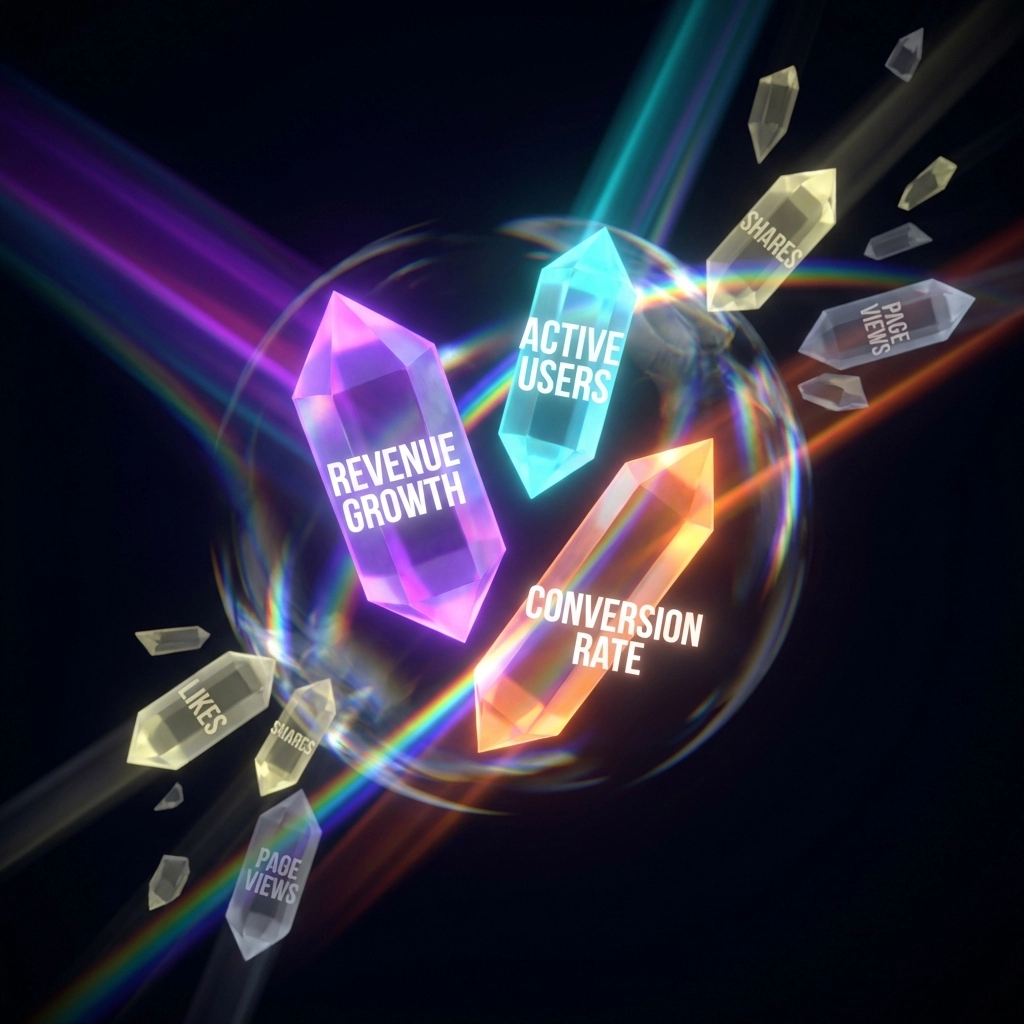
The framework limits tracking to 5-7 KPIs that directly influence decisions. More metrics create noise; fewer miss critical signals. The discipline lies in choosing metrics that force honest evaluation of whether AI moves business outcomes, not just engagement numbers.
For retention specifically, this means measuring:
- Margin protected through AI-identified intervention opportunities
- Customer lifetime value improvements from AI-optimized retention strategies
- Time from churn signal to action reduced by AI-assisted workflow
- Retention manager capacity increases from AI-automated analysis
How Niti Agents Actually Do the Work
This is where most AI tools fail: and where Niti agents deliver measurable impact. Instead of generating pretty charts that require interpretation, our agents perform the analysis, identify the problem, and suggest the specific action.
When a Niti agent spots a margin leak in your retention strategy, it doesn't just flag the issue. It calculates the financial impact, segments the affected customers, identifies the root cause, and recommends the exact intervention strategy. The output isn't a dashboard to decode: it's intelligence you can act on immediately.
Traditional AI retention tools might show you that "Customer Segment A has higher churn." Niti agents tell you that "Customer Segment A churns because your discount strategy trains them to wait for promotions, costing $47K in margin over 90 days, and here's the specific retention sequence that fixes it."

The difference is execution readiness. Most AI generates analysis that requires human interpretation, strategy development, and implementation planning. Niti agents compress that entire workflow into actionable recommendations that your team can execute immediately.
This approach eliminates dashboard paralysis because there's no dashboard to get lost in. The AI does the work of analysis, diagnosis, and strategy development. Your team does the work of execution and optimization.
Department-Specific Reality Checks
Different teams need different success definitions, and this is where most AI implementations break down. Sales teams get measured on pipeline velocity and conversion rates, not AI tool clicks. Finance teams should track profitability improvements, not cost savings claims.
For retention teams specifically, the reality check metrics include:
- Customer save rate for at-risk segments identified by AI
- Margin preservation from AI-recommended retention strategies vs. generic discount approaches
- Manager capacity expansion measured by customers-per-retention-manager ratios
- Strategy adaptation speed from churn signal to customized intervention
The critical insight: departments often inflate usage statistics while actual workflows remain unchanged. Your retention team might spend hours with AI tools but still treat all churn risks with the same generic discount strategy.
Real AI value shows up when retention strategies become dynamic, personalized, and margin-aware: when the AI doesn't just inform decisions but transforms how decisions get made.
The Strategic Implication
The market is dividing between organizations that use AI as expensive analysis tools versus those that deploy AI as operational intelligence. Pretty dashboards belong to the first category. Actionable agents belong to the second.
Organizations still measuring AI success through adoption rates and engagement metrics are optimizing for the wrong outcome. They're building AI theater instead of AI advantage.
The competitive moat isn't having AI: it's having AI that does real work. AI that identifies problems, calculates impact, and prescribes solutions. AI that transforms workflows instead of just informing them.
This is where the retention marketing space is heading. The question isn't whether you're using AI: it's whether your AI is doing the work that drives business outcomes.
If your current AI setup requires human interpretation, strategic development, and implementation planning after every insight, you're still doing the heavy lifting. The AI that wins is the AI that delivers execution-ready intelligence.
The brands winning retention battles aren't the ones with the prettiest dashboards. They're the ones with agents smart enough to spot margin leaks, strategic enough to design interventions, and automated enough to compress analysis-to-action cycles from days to minutes.
Your dashboard might look impressive, but your customers don't care about your charts. They care about personalized experiences, relevant offers, and retention strategies that feel valuable, not desperate.
The shift from dashboards to agents isn't just technological: it's strategic. It's the difference between having data and having intelligence. Between tracking activity and driving outcomes.
Demand more from your AI. Make it do the work.