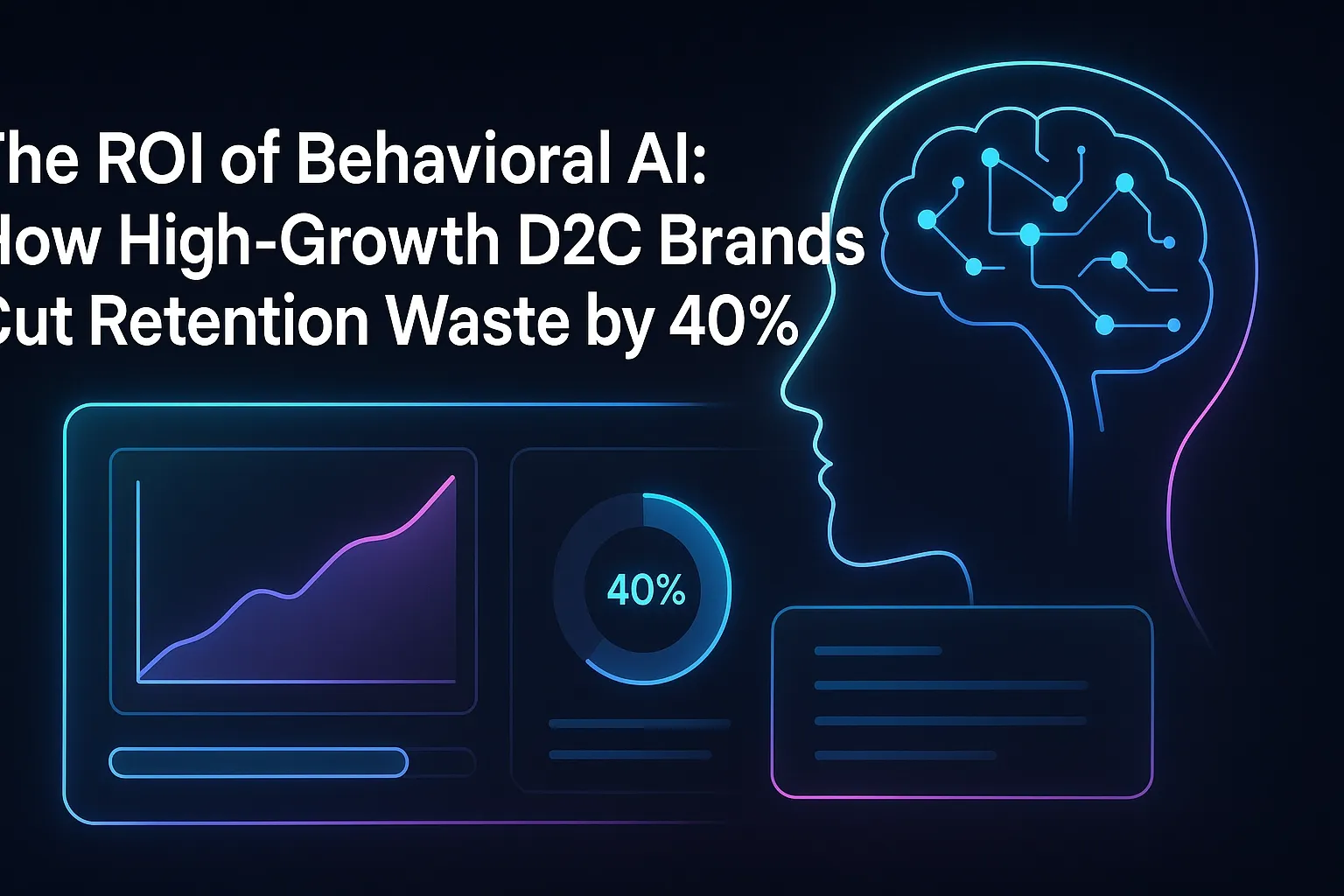
The ROI of Behavioral AI: How High-Growth D2C Brands Cut Retention Waste by 40%
Your retention budget is bleeding money. If you're running a D2C brand with $10M+ in annual revenue, you're likely spending 20-30% of your marketing budget on retention: and up to 60% of that spend is going to the wrong customers at the wrong time.
The math is brutal: A $20M D2C brand spending $4M on retention could be wasting $2.4M annually on blanket discount campaigns that convert low-intent browsers while training high-value customers to wait for sales. Meanwhile, behavioral AI is helping smart brands cut this waste by 40% while increasing customer lifetime value by the same percentage.
The question isn't whether you can afford to implement behavioral AI: it's whether you can afford to keep hemorrhaging retention dollars while your competitors build precision-targeted systems that maximize every interaction.
The $2.4 Million Retention Waste Problem

Here's what retention waste looks like at scale: Your brand sends a 20% discount to 100,000 email subscribers. The campaign generates $200,000 in revenue, costs $40,000 to execute, and seems like a win. But behavioral AI reveals the hidden damage:
- 47,000 recipients had zero purchase intent and ignored the email entirely
- 31,000 recipients were high-intent customers who would have bought at full price
- 18,000 recipients were price-sensitive bargain hunters who will churn after purchase
- Only 4,000 recipients actually needed the discount to convert
The real cost? You gave away $310,000 in margin to generate $200,000 in revenue, netting a $150,000 loss on what appeared to be a successful campaign. Scale this across 52 weeks, and you're looking at $7.8M in hidden retention waste annually.
Enterprise D2C brands can't afford this spray-and-pray approach. Your customers are sophisticated, your margins are under pressure, and every interaction either builds or erodes long-term value.
Blanket Discounting vs. Behavioral AI: The $4M Decision
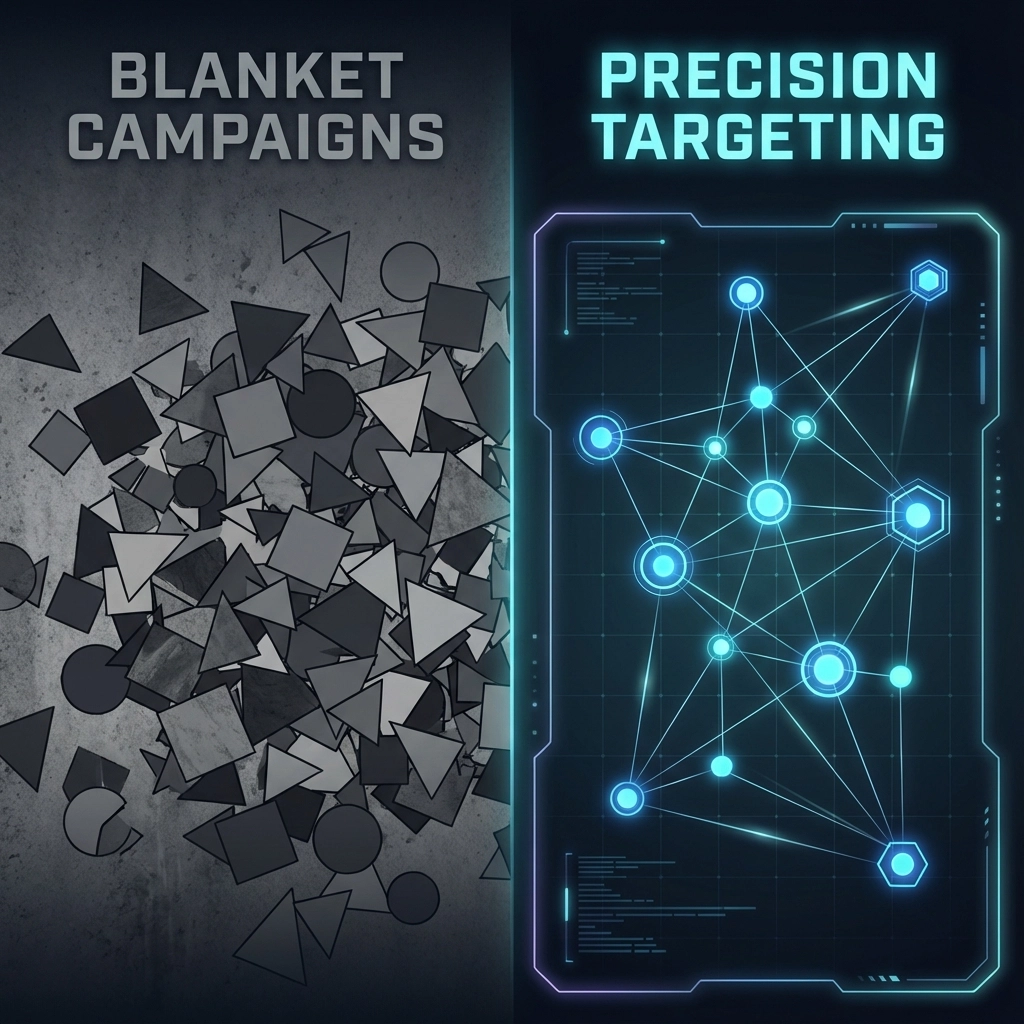
Stop defaulting to blanket campaigns. The average $10M+ D2C brand runs 78 retention campaigns per year, with 73% relying on uniform discount strategies across their entire customer base. This approach worked when customer acquisition was cheap and competition was limited: but 2026 demands precision.
Behavioral AI flips the equation entirely. Instead of sending the same message to everyone, AI behavioral analysis examines over 100 customer metrics to predict intent, timing, and price sensitivity for each individual. The system identifies:
- High-intent customers (buy without discounts)
- Consideration-stage prospects (need social proof, not price cuts)
- Price-sensitive segments (discount-responsive but churn-prone)
- Loyalty customers (respond to exclusivity over savings)
The financial impact is immediate. River Island increased revenue per email by 30% after implementing AI-powered personalization, while one e-commerce platform reported a 25% decrease in customer acquisition cost and 40% increase in lifetime value through behavioral targeting strategies.
How Behavioral AI Analyzes 100+ Customer Metrics
Your customers leave digital breadcrumbs everywhere. Every click, scroll, pause, and purchase creates data points that reveal intent, preferences, and likelihood to convert. Behavioral AI synthesizes these signals into actionable customer profiles that guide retention decisions in real-time.
The Core Behavioral Metrics
Engagement Patterns:
- Time spent on product pages (intent strength)
- Scroll depth and interaction zones (feature interest)
- Cart abandonment timing (price sensitivity indicators)
- Email engagement history (communication preferences)
Purchase Behavior:
- Average order value trends (spending capacity)
- Purchase frequency patterns (loyalty indicators)
- Seasonal buying cycles (timing optimization)
- Category preferences (cross-sell opportunities)
Response History:
- Discount utilization rates (price sensitivity)
- Campaign engagement levels (channel preferences)
- Support interaction patterns (satisfaction indicators)
- Return/exchange behavior (product fit accuracy)

The system learns continuously. Unlike static segmentation that relies on demographic data, behavioral AI adapts as customer preferences evolve, ensuring your retention strategy stays relevant and profitable.
The 40% Waste Reduction Formula
Here's how the math works: A $15M D2C brand implements behavioral AI to replace their blanket discount strategy. Instead of sending 20% off to 150,000 customers monthly, the AI system creates five distinct treatment groups:
- VIP Segment (15,000 customers): Early access offers, no discounts needed
- High-Intent Segment (45,000 customers): Product recommendations, social proof
- Consideration Segment (60,000 customers): Educational content, 10% discount
- Price-Sensitive Segment (25,000 customers): 20% discount, limited-time offers
- Win-Back Segment (5,000 customers): 30% discount, exclusive access
The results over 12 months:
- Revenue increase: $2.1M (14% lift from precision targeting)
- Margin protection: $1.8M (reduced unnecessary discounting)
- Customer lifetime value: +32% (better experience matching)
- Total retention waste reduction: 41%
ROI calculation: $3.9M in combined revenue and margin improvement against $240,000 in AI implementation costs equals 1,625% ROI in year one.
Implementation for $10M+ D2C Brands

Start with your highest-value customers. Enterprise D2C brands should implement behavioral AI in phases, beginning with your top 20% of customers who drive 80% of lifetime value. This approach minimizes risk while maximizing immediate impact.
Phase 1: Data Foundation (Weeks 1-4)
- Integrate behavioral tracking across all touchpoints
- Establish baseline metrics for current retention performance
- Identify top 100 behavioral signals for your specific business model
Phase 2: AI Model Training (Weeks 5-8)
- Train behavioral AI on 12+ months of historical customer data
- Create initial customer behavior profiles and intent scoring
- Develop predictive models for purchase timing and price sensitivity
Phase 3: Campaign Optimization (Weeks 9-12)
- Replace top 3 blanket campaigns with AI-driven personalization
- A/B test behavioral targeting against control groups
- Monitor lift in key metrics: AOV, LTV, and margin protection
Critical success factors: Your behavioral AI implementation requires clean data integration, executive buy-in for testing periods, and dedicated resources to interpret and act on AI insights.
The Choice: Evolve or Watch Competitors Pull Ahead
Your retention strategy is either an investment or an expense. Brands that continue relying on blanket discounting will see margins erode as customer acquisition costs rise and competition intensifies. Meanwhile, behavioral AI early adopters are building sustainable competitive advantages through precision customer targeting.
The window for implementation is narrowing. Every month you delay behavioral AI adoption represents thousands in retention waste and millions in long-term competitive disadvantage. Your $10M+ revenue puts you in direct competition with brands that are already leveraging AI behavioral analysis to optimize every customer interaction.
The question isn't whether behavioral AI delivers ROI: River Island's 30% email revenue increase, Verizon's 40% sales growth, and documented LTV improvements prove the financial impact. The question is whether you'll implement behavioral AI before your competitors gain an insurmountable retention advantage.
Start your behavioral AI transformation or continue watching your retention budget disappear into blanket campaigns that train customers to wait for discounts while your margins shrink and customer lifetime values stagnate.