
The $10M+ D2C Retention Playbook: Using Kano Analysis to Protect Margins at Scale

Your $10M+ D2C brand is hemorrhaging margins through retention strategies that fundamentally misunderstand customer psychology. While competitors throw discounts at every retention challenge, the most successful enterprise brands are deploying Kano Analysis to surgically categorize customer expectations and protect profitability at scale.
The sobering reality: 73% of high-revenue D2C brands are over-investing in "must-have" retention features while completely missing the "delighters" that actually drive loyalty. This systematic misallocation is costing enterprise brands an average of $2.3M annually in unnecessary retention spend.
The Fatal Flaw in Enterprise D2C Retention
Most $10M+ brands operate under a dangerous assumption: more retention investment equals better results. This spray-and-pray mentality leads to expensive retention programs that customers view as basic expectations rather than loyalty drivers.
Enter Kano Analysis – the Japanese quality management framework that's revolutionizing how enterprise D2C brands understand customer satisfaction. Originally developed by Dr. Noriaki Kano for product development, this methodology categorizes customer needs into three critical buckets that completely transform your retention ROI.

Understanding the Kano Framework for D2C Retention
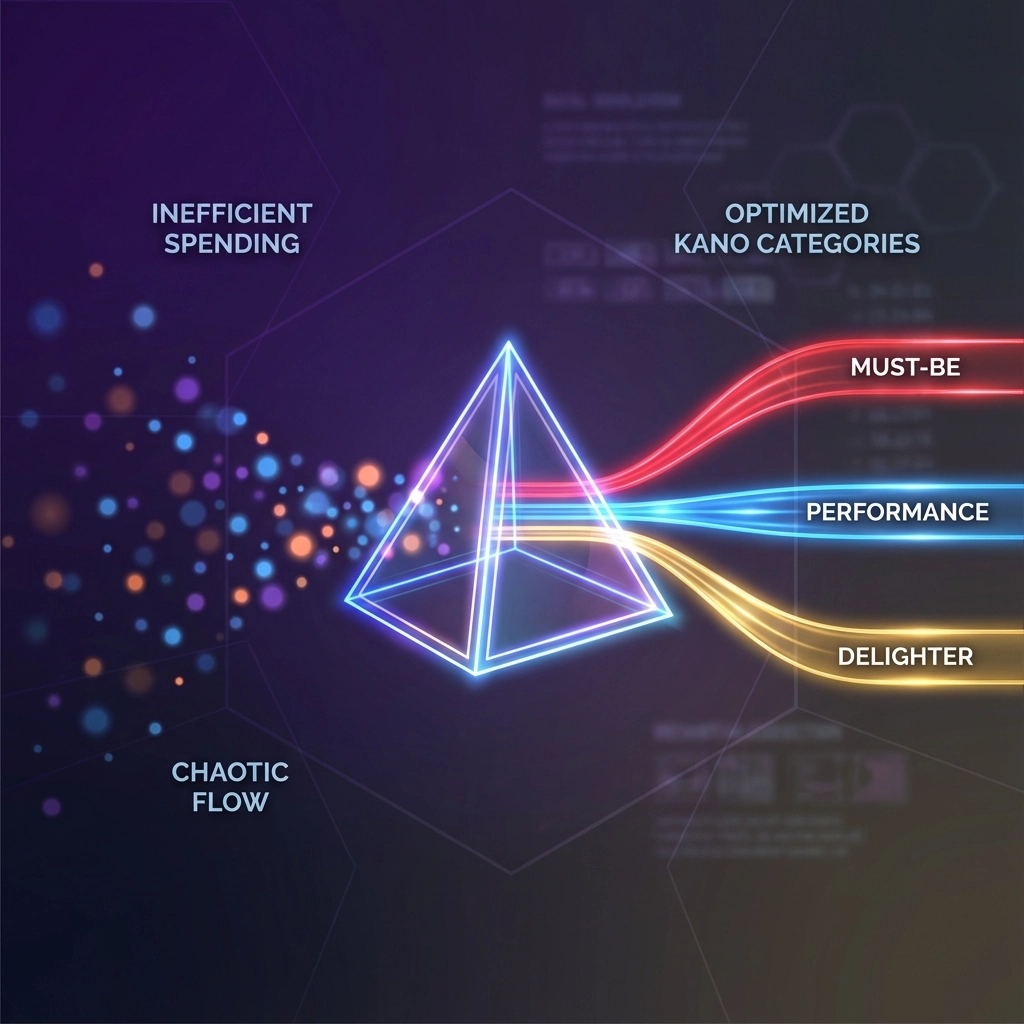
Kano Analysis dissects customer preferences into three fundamental categories:
Must-Haves (Basic Expectations) These are retention features your customers expect as standard. Fast shipping, easy returns, responsive customer service – their presence doesn't increase satisfaction, but their absence creates immediate dissatisfaction. Over-investing here is pure margin destruction.
Performers (Linear Satisfaction) These features create proportional satisfaction increases with investment. Loyalty points, personalized recommendations, exclusive access – more investment yields predictable returns. This is where most enterprise brands focus their retention budgets.
Delighters (Exponential Satisfaction) These unexpected features create disproportionate loyalty gains with minimal investment. A handwritten note, surprise upgrade, or predictive customer service – small touches that generate massive emotional connection and word-of-mouth growth.
The Enterprise D2C Application: Beyond Basic Retention
For your $10M+ brand, Kano Analysis transforms retention from cost center to profit driver. Here's how sophisticated brands are implementing this framework:
Must-Have Retention Audit
Stop over-investing in customer expectations. Enterprise brands typically allocate 60% of retention budgets to must-haves – features that provide zero competitive advantage. Your customers expect:
- Seamless checkout and payment processing
- Basic order tracking and updates
- Standard return/exchange policies
- Responsive customer service during business hours
The margin protection strategy: Optimize these efficiently, then redirect budget to performers and delighters. One enterprise beauty brand reduced must-have spending by 40% while maintaining satisfaction scores by simply streamlining rather than over-engineering basic expectations.
Performer Optimization Framework
Performers are your scaling engine – features where increased investment yields proportional returns. For enterprise D2C brands, key performers include:
- Personalized product recommendations (ROI scales with data sophistication)
- Tiered loyalty programs (satisfaction increases with tier benefits)
- Exclusive product access (value scales with exclusivity level)
- Customized retention communications (effectiveness scales with personalization depth)
Implementation protocol: Systematically test investment levels in performer categories. One $50M fashion brand discovered their loyalty program ROI peaked at a specific tier structure – additional investment yielded diminishing returns.

Delighter Discovery and Deployment
This is where enterprise brands separate themselves from commodity competitors. Delighters require minimal investment but create exponential loyalty gains. Successful enterprise D2C brands are discovering delighters through:
Behavioral pattern analysis: What unexpected actions create the strongest positive responses? One home goods brand found that proactive shipping delay notifications (before customers asked) generated higher satisfaction than expedited shipping.
Micro-moment optimization: Small touches during key customer journey moments. A supplement brand's "congratulations on your 30-day streak" personal note generated 340% higher retention than equivalent discount offers.
Predictive service delivery: Solving problems customers don't know they have yet. Enterprise brands using AI to predict and prevent issues before customer contact create massive loyalty advantages.
The Margin Protection Implementation Strategy
Here's your systematic approach to implementing Kano Analysis for margin protection:
Phase 1: Customer Expectation Mapping (Weeks 1-4)
Survey your highest-value customer segments to categorize current retention features. Use the Kano questionnaire methodology:
- Functional question: "How do you feel if this feature is present?"
- Dysfunctional question: "How do you feel if this feature is absent?"
Critical insight: Enterprise customers often have different expectation hierarchies than mass market segments. Your $10M+ brand's customers may view premium packaging as a must-have, while smaller brands treat it as a delighter.
Phase 2: Investment Reallocation (Weeks 5-8)
Systematically reduce over-investment in must-haves while maintaining quality standards. The goal isn't elimination – it's efficiency optimization. Redirect savings into performer and delighter development.
Financial framework: Must-haves should consume maximum 25% of retention budget, performers 60%, and delighters 15%. Most enterprise brands discover they're allocating 60%+ to must-haves.
Phase 3: Delighter Development Pipeline (Weeks 9-16)
Create systematic delighter discovery and testing protocols. Enterprise brands need repeatable processes for finding and scaling unexpected satisfaction drivers.
Testing methodology: Deploy micro-tests with high-value customer segments. Measure not just satisfaction scores but downstream behaviors – repeat purchase rates, referral generation, and lifetime value improvements.
The Enterprise Results: Quantified Margin Protection
The financial impact of proper Kano implementation is dramatic for $10M+ D2C brands:
Margin protection: Average 18% reduction in retention costs while maintaining customer satisfaction scores. One enterprise electronics brand saved $4.2M annually by optimizing must-have investment.
Loyalty amplification: Delighter-focused brands see 43% higher customer lifetime value with minimal investment increases. Small touches create disproportionate emotional connections.
Competitive differentiation: While competitors compete on performer features (discounts, points, tiers), delighter-focused brands create unique value propositions that resist commoditization.
The AI-Powered Kano Evolution
Modern enterprise D2C brands are deploying AI to scale Kano insights across customer segments and product lines. Advanced implementations include:
Dynamic expectation tracking: AI monitors how customer expectations evolve, automatically recategorizing features from delighters to performers to must-haves over time.
Segment-specific Kano mapping: Different customer cohorts have distinct expectation hierarchies. AI identifies these patterns and customizes retention approaches accordingly.
Predictive delighter identification: Machine learning analyzes customer behavior patterns to predict which unexpected features will create satisfaction spikes before testing.
Your Strategic Choice Point
Every $10M+ D2C brand faces this retention reality: Continue competing on expensive performer features while hemorrhaging margins, or deploy Kano Analysis to systematically understand and optimize customer satisfaction investments.
The brands scaling past $50M revenue aren't outspending competitors – they're outsmarting them through scientific understanding of customer psychology. They've stopped treating retention as a cost center and transformed it into a precision profit driver.
Your retention strategy is either protecting margins through systematic customer understanding, or destroying them through misallocated investment. Kano Analysis provides the framework to ensure every retention dollar generates maximum satisfaction and loyalty returns.
The question isn't whether your customers have evolving expectations – it's whether you understand them scientifically enough to protect your margins while exceeding them strategically.