
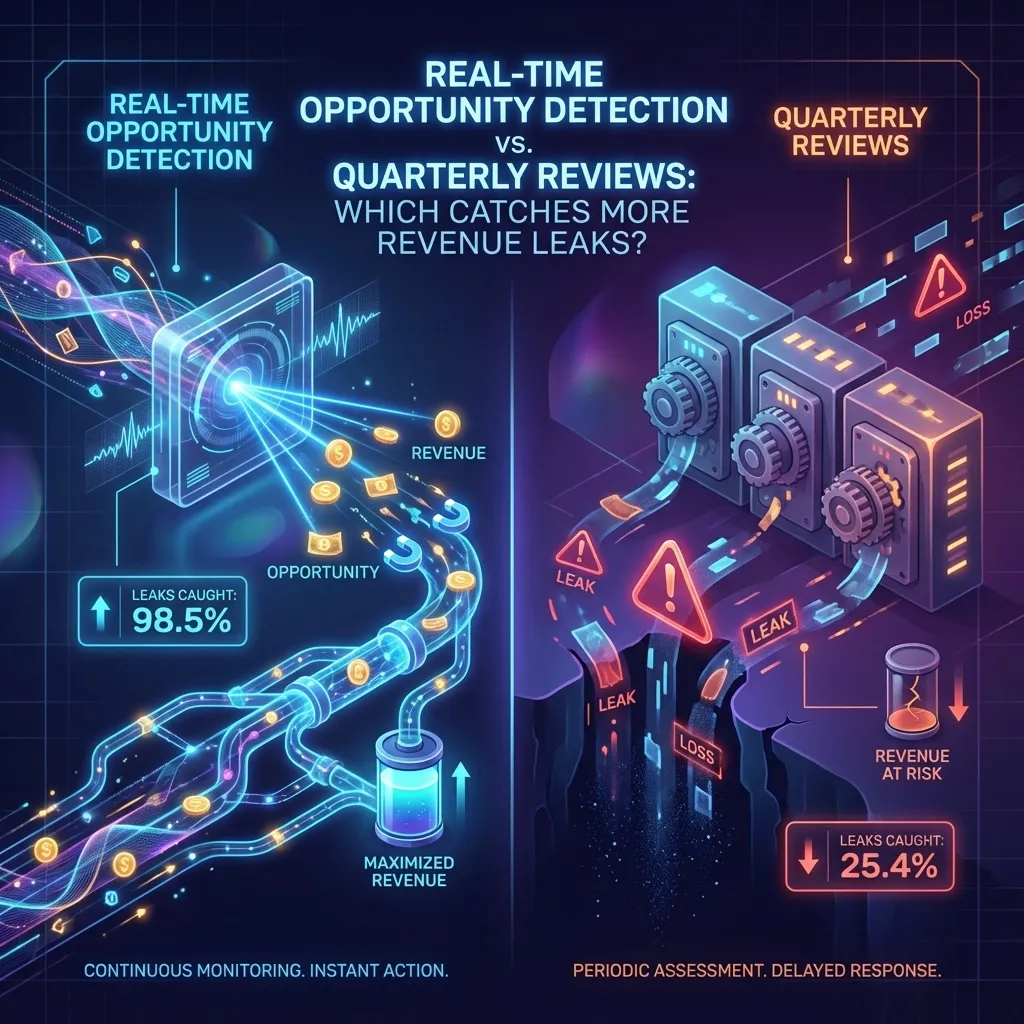
Real-Time Opportunity Detection vs. Quarterly Reviews: Which Catches More Revenue Leaks?
Picture this: You're running an e-commerce business, and somewhere in your customer base, a high-value customer is getting frustrated with slow checkout times. In a traditional quarterly review system, you might catch this issue three months later when you analyze customer feedback data. By then? They've already switched to a competitor and taken their $2,000 annual spend with them.
Now imagine having a real-time opportunity detection system that flags this friction point within hours, automatically triggering a personalized intervention that not only saves the customer but increases their lifetime value by 25%.
This isn't science fiction: it's the difference between reactive quarterly reviews and proactive real-time opportunity detection. And for businesses serious about retention optimization, the choice is becoming crystal clear.
The Revenue Leak Reality Check
Before we dive into the comparison, let's get real about what we're actually fighting here. Revenue leaks aren't just about customers leaving: they're about missed opportunities, declining engagement, and profit erosion that happens gradually, then suddenly.
Behavioral AI research shows that most revenue leaks start small:
- A VIP customer reduces their purchase frequency by 20%
- Product engagement drops by 15% among your highest-value segment
- Cart abandonment increases by 10% in a specific demographic
- Customer service response times slip, causing satisfaction scores to dip
These micro-signals compound over time. What starts as a 5% decline in engagement can snowball into a 40% reduction in customer lifetime value if left unchecked.
Traditional Quarterly Reviews: The Good, Bad, and Ugly
Let's be honest about quarterly reviews: they've been the backbone of business analytics for decades, and there's a reason for that.
What Quarterly Reviews Do Well
Quarterly reviews excel at providing comprehensive, strategic overviews. They give you the big picture, allowing you to spot macro trends and make high-level strategic decisions. When you're planning budgets, setting team goals, or presenting to stakeholders, quarterly data provides the stability and context needed for major decisions.
They're also less overwhelming for teams. Instead of constant notifications and daily fire-drills, quarterly reviews create focused periods of analysis and planning.
The Revenue Leak Problem
But here's where quarterly reviews fall short in our modern, fast-paced market: timing.
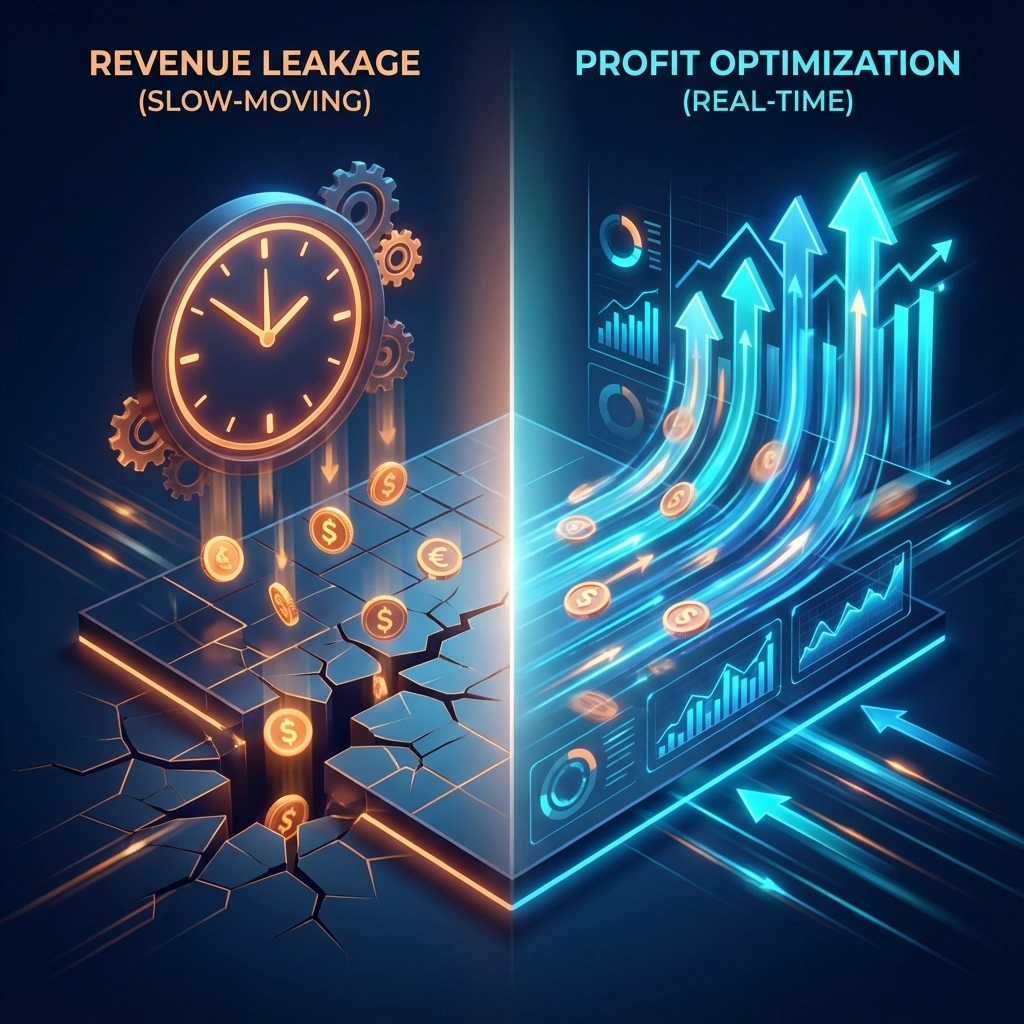
Think about it: if a revenue leak starts in month one of your quarter, you're essentially giving it a three-month head start. That's 90 days for problems to compound, customers to churn, and opportunities to slip away.
Consider these scenarios:
- A pricing strategy backfires, but you only discover it 60 days later when quarterly revenue numbers come in
- Your top customer segment starts engaging less with your product, but the trend is buried in quarterly averages
- A competitor launches a superior feature, and your customers begin testing alternatives while you're waiting for quarterly feedback data
Real-world impact: Companies relying solely on quarterly reviews typically catch revenue-impacting issues 2-3 months after they begin. By that point, the average business has already lost 15-25% of the potential recoverable revenue.
Real-Time Opportunity Detection: The Modern Approach
Real-time opportunity detection flips the script entirely. Instead of waiting for scheduled reviews, these systems continuously monitor customer behavior, engagement patterns, and revenue signals to identify opportunities and threats as they emerge.
How Real-Time Systems Catch Revenue Leaks Faster
Modern AI behavioral analysis platforms monitor hundreds of micro-signals simultaneously:
Engagement Signals: Page views, feature usage, session duration, click-through rates
Purchase Behavior: Frequency changes, basket size variations, category shifts
Communication Patterns: Email opens, response times, support ticket sentiment
Lifecycle Indicators: Onboarding completion, milestone achievements, usage depth
When these signals deviate from established patterns, the system flags potential issues immediately: not in three months.
The Compound Advantage
Here's where it gets interesting: real-time systems don't just catch problems faster: they identify opportunities that quarterly reviews miss entirely.
For example, a behavioral AI system might detect that customers who purchase Product A within 30 days of signup have 40% higher lifetime values. A quarterly review might eventually notice that some customers are more valuable, but it likely wouldn't pinpoint the specific timing pattern that creates this value.

Real-time opportunity detection allows you to:
- Intervene within hours when high-value customers show early churn signals
- Automatically trigger upsell campaigns when behavioral patterns indicate readiness
- Adjust pricing or promotions in real-time based on demand signals
- Identify and replicate successful customer journey patterns immediately
The Head-to-Head Comparison
| Factor | Quarterly Reviews | Real-Time Opportunity Detection |
|---|---|---|
| Detection Speed | 1-3 months | Hours to days |
| Revenue Recovery | 15-25% of potential | 80-90% of potential |
| Intervention Timing | After damage is done | Before problems compound |
| Opportunity Capture | Misses time-sensitive chances | Capitalizes on fleeting windows |
| Resource Investment | High upfront, periodic | Distributed, ongoing |
| False Positives | Low (data is aggregated) | Higher (requires tuning) |
The Behavioral AI Advantage
What makes modern real-time systems particularly powerful is their use of behavioral AI. Unlike rule-based systems that only flag predetermined scenarios, behavioral AI learns patterns and predicts outcomes based on complex customer behavior interactions.

Traditional rule: "Flag customers who haven't purchased in 60 days"
Behavioral AI rule: "Flag customers whose engagement pattern matches historical pre-churn behavior, accounting for seasonality, customer segment, purchase history, and 47 other variables"
This sophistication means fewer false alarms and more accurate opportunity identification.
Which Catches More Revenue Leaks?
The data is pretty clear: real-time opportunity detection systems catch significantly more revenue leaks than quarterly reviews, and they catch them when they're still fixable.
Research findings:
- Companies using real-time systems recover 3.2x more revenue from at-risk customers
- Profit optimization improves by an average of 18% within the first year
- Customer lifetime value increases by 15-30% due to earlier intervention
- 68% fewer high-value customers churn compared to quarterly-only approaches
But here's the nuance: the best-performing companies don't abandon quarterly reviews entirely. They use real-time systems for immediate tactical responses and quarterly reviews for strategic planning and trend analysis.
The Implementation Reality
Let's address the elephant in the room: implementing real-time opportunity detection isn't just about buying software and flipping a switch.
Common challenges:
- Data integration: Your real-time system needs access to customer data, purchase history, engagement metrics, and behavioral signals
- Alert fatigue: Too many notifications can overwhelm teams and reduce response effectiveness
- Response capacity: Having real-time alerts is useless if your team can't act on them quickly
- False positive management: Early systems often flag too many non-issues
Success factors:
- Start with your highest-value customer segments to maximize impact
- Invest in response automation for common scenarios
- Train teams on rapid intervention techniques
- Regularly calibrate alert thresholds to reduce false positives

The Bottom Line: Speed Wins
In today's competitive landscape, the companies that identify and respond to revenue opportunities fastest are the ones that win. Real-time opportunity detection doesn't just catch more revenue leaks: it fundamentally changes how you think about customer relationships and business optimization.
Quarterly reviews still have their place for strategic planning and comprehensive analysis. But for day-to-day retention optimization and profit optimization, real-time systems are becoming table stakes.
The question isn't whether you should implement real-time opportunity detection: it's how quickly you can get started and how effectively you can respond to the opportunities it reveals.
Ready to see how real-time opportunity detection could transform your retention strategy? Discover more about AI-powered customer retention and learn how top brands are using these systems to cut churn by 40%.