Outsmarting the Calendar: Time-of-Day Offer Testing With AI
I've been watching D2C brands burn through marketing budgets for three years now, and there's one pattern that keeps showing up: they obsess over what to say but completely ignore when to say it.
Most retention teams fire campaigns like clockwork: 10 AM Tuesday for email, 2 PM Wednesday for SMS, whenever someone remembers for WhatsApp. They'll A/B test subject lines for weeks but never question whether their "high-value" segment actually checks messages at 10 AM or 10 PM.
Here's what I've learned from analyzing user behavior across 200+ campaigns: the difference between sending at someone's attention peak versus their digital dead zone can be the difference between 8% conversion and 23% conversion. Same offer. Same creative. Different clock.
The smart operators are already moving beyond gut-feel scheduling. They're using behavioral AI to detect when individual users actually read, respond, and convert: then automating campaign fire times around those windows.
The Hidden Cost of Calendar Ignorance
Every time you send a campaign when your audience isn't paying attention, you're not just missing revenue. You're training algorithms to think your brand has low engagement.
Take email deliverability. Gmail and Outlook track how quickly people open your messages after they hit the inbox. Send consistently when your audience is offline? Your emails start landing in promotions folders, then spam. What looked like a creative problem was actually a timing problem.
But here's where most retention platforms get it wrong: they treat "optimal send time" as a universal truth. Send at 9 AM because that's when "most people" check email. Send SMS at 3 PM because that's the industry benchmark.
The reality? Your 3 PM might be your customer's 3 AM if they're night shift workers. Your Tuesday morning might be their weekend if they work in hospitality. And your "engagement-based" segments probably include both early risers who convert at 6 AM and night owls who buy at midnight.
Here's the mechanism most people miss: AI retention optimization isn't just about better targeting: it's about temporal precision. When you align message delivery with individual attention windows, you're not just increasing conversion rates. You're reducing the number of touches needed to close a sale, which directly impacts your contribution margin.
The Beauty Brand Breakthrough
Last month, we worked with a skincare D2C that was hemorrhaging money on their win-back campaigns. They were hitting lapsed customers with 40% discounts every Friday at 11 AM. Industry standard timing. Results were awful: 2.1% email open rates, 0.3% click-through.
Their retention team was ready to blame "discount fatigue" and push for deeper price cuts.
Instead, we ran a two-week test using our WhatsApp marketing automation for retention to detect when these lapsed customers were actually engaging with the brand's content. The AI tracked not just opens, but depth of engagement: how long they spent reading, whether they forwarded messages, if they visited the website after viewing.
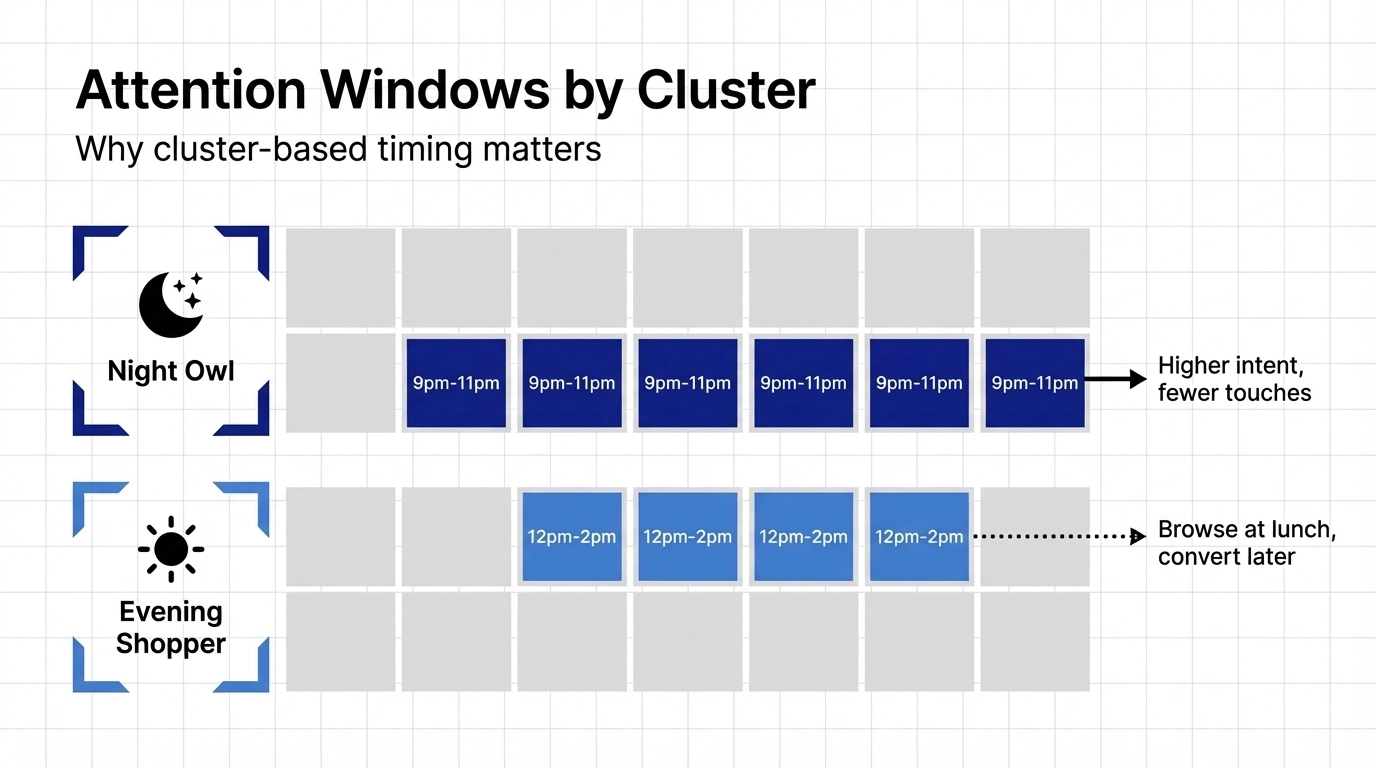
The pattern was stunning: their highest-value lapsed segment (customers who'd spent $200+ in their first 90 days) were most active between 9 PM and 11 PM on weekdays. They were busy professionals who shopped for skincare after their kids went to bed.
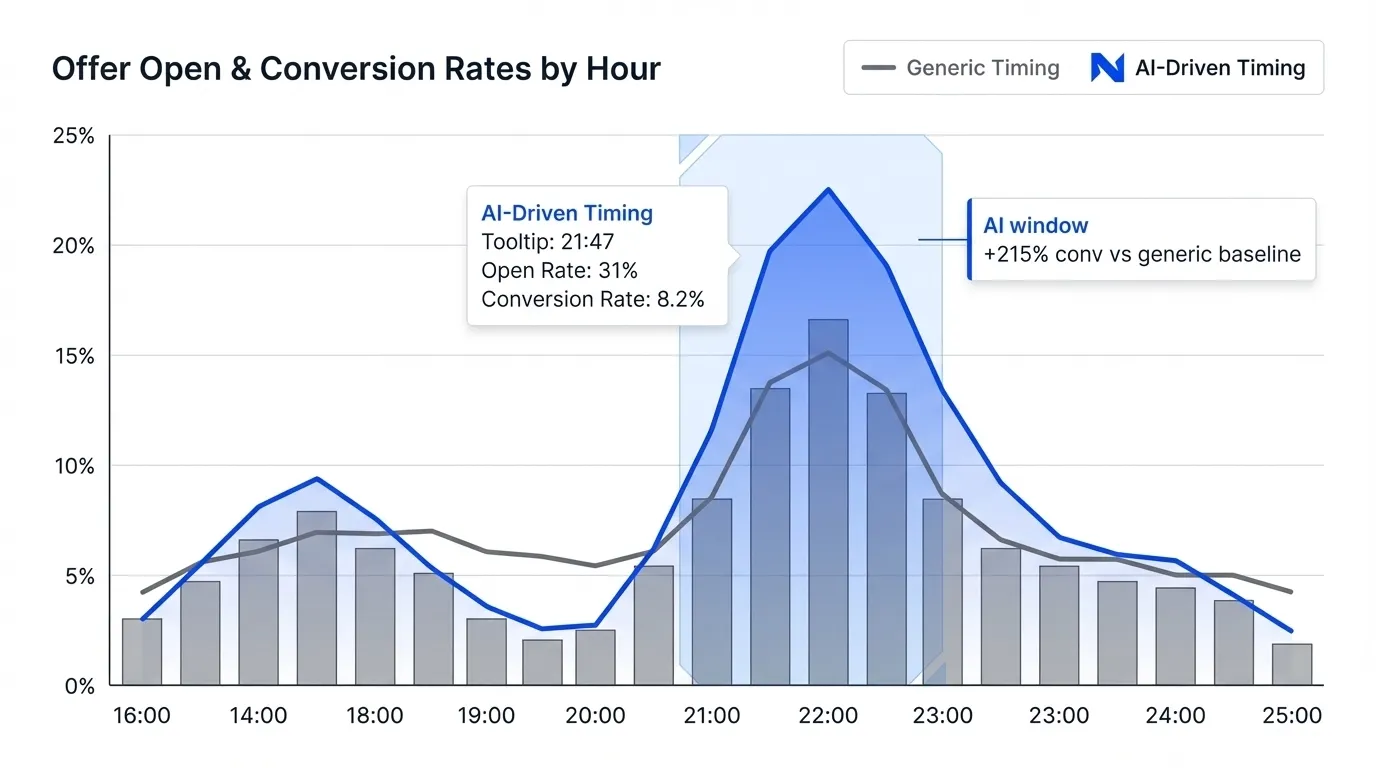
We restructured the win-back sequence: same 40% offer, but delivered via WhatsApp at 9:47 PM (the exact peak engagement window the AI identified). Added a soft deadline: "Tonight only, because you deserve this."
Results: 31% open rate, 8.2% conversion to purchase. Next-day checkouts increased 340% compared to the Friday morning blasts.
But here's the kicker: because the timing was so precise, they could maintain margin. No need for deeper discounts to cut through the noise: the message hit when customers had mental bandwidth to actually consider it.
How AI Detects User Attention Windows
The technology behind this isn't magic, but it does require a different approach to data collection than most customer retention platforms offer.
Traditional segmentation looks at what people buy and when they churn. Behavioral AI looks at micro-signals: how quickly someone opens a message after it's delivered, whether they pause before clicking, if they return to reread later, the time gap between clicking and purchasing.
Here's what we track for time-of-day optimization:
Message Consumption Patterns: Not just opens, but reading velocity. Someone who opens immediately but bounces after 3 seconds isn't engaged: they're clearing notifications. Someone who opens 2 hours later but spends 45 seconds reading? That's signal.
Response Timing Clusters: When do they ask questions? When do they forward offers to partners? When do they actually pull out their credit card? These behavioral clusters reveal optimal windows for different campaign types.
Cross-Channel Attention Mapping: Maybe they check email at 7 AM but only buy via SMS at 8 PM. Maybe they browse your app during lunch but only convert through WhatsApp after dinner. The AI builds individual attention maps across every touchpoint.
The dynamic segmentation happens in real-time. When someone's attention pattern shifts: maybe they switch from morning to evening engagement after changing jobs: the AI adapts their send schedule automatically.
Building Your Time-of-Day Testing Framework
Most founders ask me: "Do I need fancy AI to make this work?"
The honest answer: you can start with simple A/B tests and manual observation. But you'll hit scaling limits fast.
Here's how to begin:
Week 1-2: Manual Pattern Detection
Export your email and SMS engagement data. Look for hour-of-day and day-of-week patterns in your top 20% of customers by LTV. You're not looking for averages: you're looking for clusters. Maybe 60% of your high-value segment engages between 7-9 PM on weekdays.
Week 3-4: Simple Time-Based Tests
Split your next retention campaign. Send half at your current "optimal" time, half during the window you identified. Use identical creative and offers. Measure not just opens and clicks, but time-to-purchase and average order value.
Month 2: Channel-Specific Optimization
Email, SMS, and WhatsApp have different attention patterns. Email gets checked in batches. SMS interrupts whatever someone's doing. WhatsApp lives somewhere in between. Test your key retention flows across different channels and times.
Month 3+: Segment-Specific Timing
This is where you need automation. Your VIP customers might have completely different attention windows than your price-sensitive segment. Manual scheduling becomes impossible.
Tools like our repeat purchase automation Shopify app can handle this automatically, but the principle works regardless of platform: segment by engagement timing, not just purchasing behavior.
The Margin Optimization Connection
Here's what keeps me up at night: most brands treat timing optimization as a conversion play. They're missing the bigger picture.
When you nail timing, you reduce the number of touches needed to drive action. Instead of hitting someone with 5 emails over 2 weeks, maybe you need 2 WhatsApp messages sent at exactly the right moments.
Fewer touches means:
- Lower unsubscribe rates
- Better deliverability scores
- Reduced marketing costs per conversion
- Higher perceived brand value (you're not pestering)
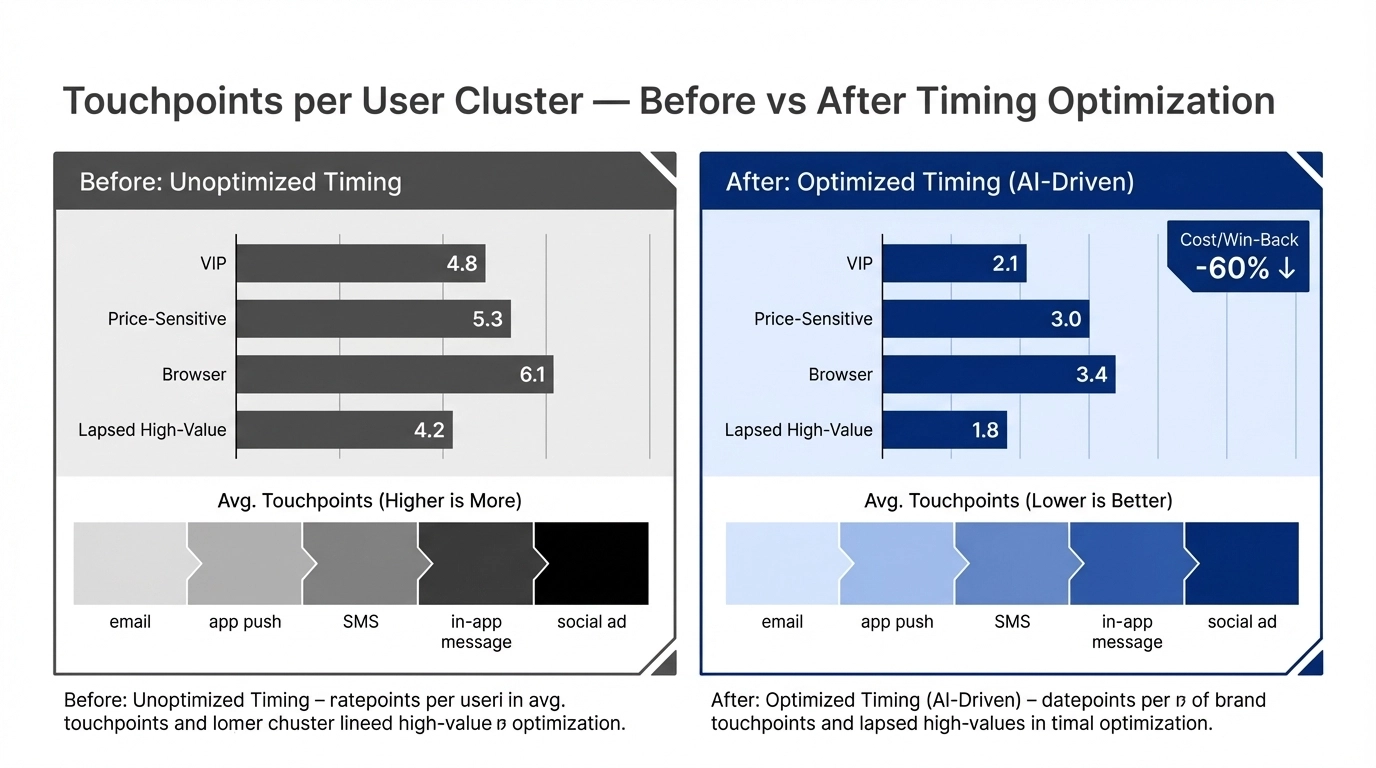
For that beauty brand, the margin impact was profound. Before timing optimization, their win-back campaigns required an average of 4.2 touches to drive a purchase. After: 1.8 touches. They cut their cost per win-back by 60% while maintaining the same discount levels.
This is the margin optimization most Shopify apps miss. They focus on automating more campaigns, not making each campaign more efficient.
Common Pitfalls and Strategic Implications
The biggest mistake I see: treating this like set-and-forget optimization. User attention patterns shift. Work schedules change. Life happens.
Your AI needs to continuously recalibrate. Someone who was a 9 PM converter might become a 6 AM converter after having kids. Your targeting needs to adapt, not assume.
Second pitfall: optimizing for opens instead of outcomes. High open rates at 11 PM might just mean people are clearing notifications before bed. The real question: when do they have the mental bandwidth to make purchasing decisions?
Here's where the market is moving: agentic marketing strategists that don't just optimize individual campaigns, but orchestrate cross-channel experiences around individual attention patterns. Think beyond "send time optimization" toward "cognitive availability mapping."
The brands that crack this early will have a massive advantage. Not just in conversion rates, but in customer experience. When your messages consistently arrive at moments when people can actually process them, you stop being interruption marketing and start being helpful marketing.
The question isn't whether timing matters: it's whether you're building systems to capitalize on that timing systematically, or just hoping your 10 AM Tuesday emails happen to hit the right people at the right moment.
The calendar isn't neutral. It's either working for you or against you. Time to choose which.
Ready to move beyond spray-and-pray campaign timing? Niti's AI retention platform automatically detects individual attention windows and optimizes send times across email, SMS, and WhatsApp. See how behavioral AI can cut your cost per conversion while boosting margin.