Introducing Agentic Growth Strategist: The Future of Growth Marketing
The marketing function is experiencing its most profound transformation in decades. We've automated email sends, optimized ad bids, and streamlined campaign execution. Yet one critical function has remained stubbornly manual: STRATEGIC THINKING ITSELF.
That's changing right now.
An Agentic Growth Strategist is an autonomous AI system that performs the complete role of a human growth strategist. Not a tool that assists. Not a copilot that suggests. A system that autonomously analyzes customer data, identifies growth opportunities, creates comprehensive campaign strategies, designs margin-aware offers, and produces ready-to-execute marketing plans—continuously, at scale, without human intervention for every decision.
For mid-market D2C brands spending tens of thousands monthly on customer acquisition while drowning in retention complexity, this represents a complete reimagining of how growth happens.
The Problem We've Been Ignoring
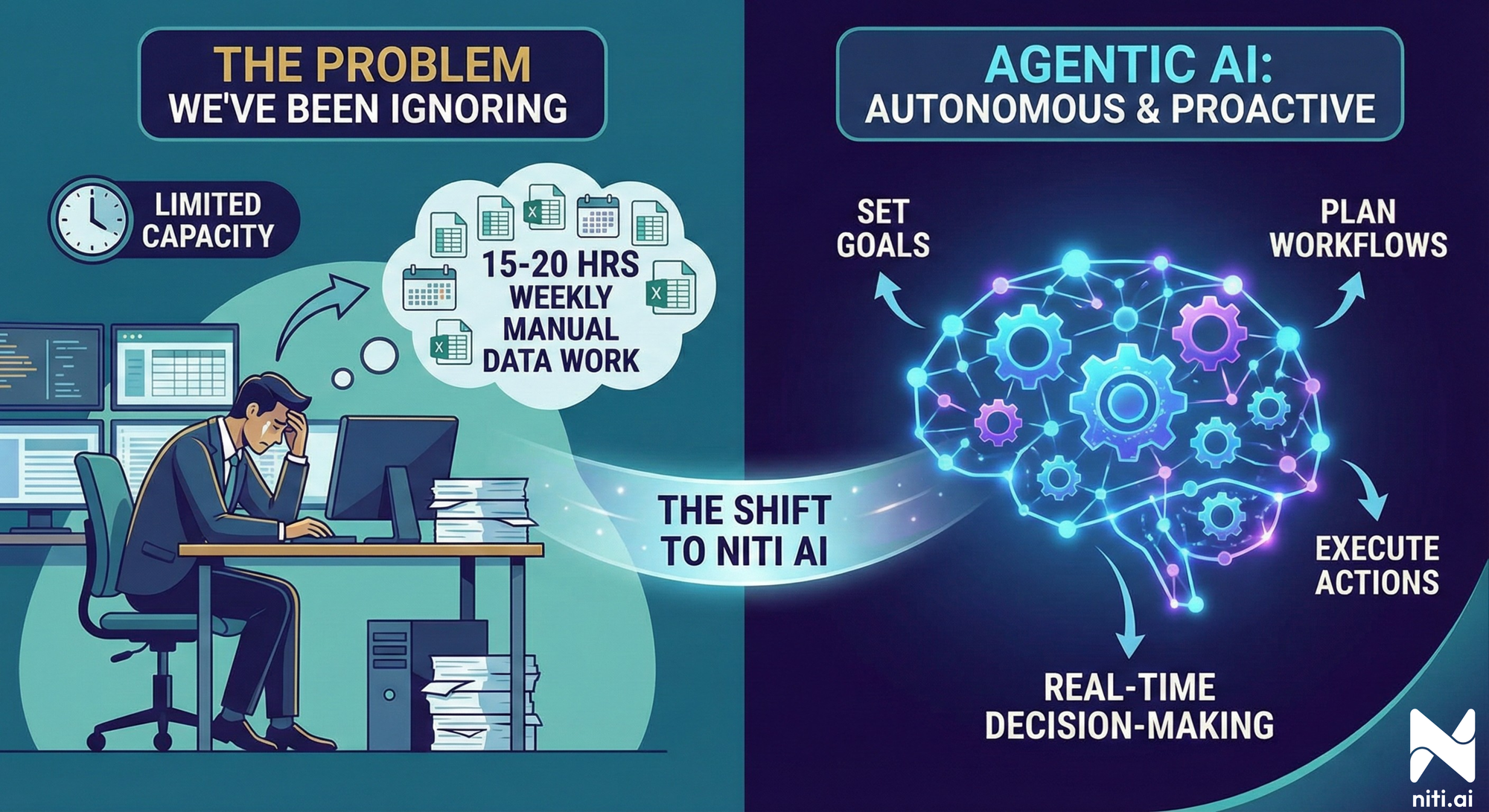
Here's the uncomfortable truth about modern marketing teams: your strategist can analyze maybe 15-20 customer variables when building segments. They might produce 2-3 comprehensive campaigns per week if they're exceptional. And they spend 15-20 hours weekly on work they hate—pulling data from five different sources, building segments in spreadsheets, manually calculating which offers make financial sense.
Meanwhile, your customer base generates hundreds of behavioral signals daily. High-value customers who haven't purchased in 45 days. Product categories seeing unusual browse activity. Discount-sensitive segments that could respond to non-monetary offers. The opportunities are there. Your team just can't see them fast enough or act on them at scale.
The hiring solution doesn't work either. Finding experienced growth strategists takes 3-6 months. Training them takes another 3-6 months. Total compensation hits $150,000 annually. And average tenure? Just 18 months before you're hiring again.
What Makes AI Systems "Agentic"
The term "agentic" isn't marketing jargon—it reflects a fundamental shift in AI capabilities.
Traditional AI systems are reactive. They respond to prompts, answer questions, execute predefined workflows. They're powerful assistants but require human direction for each task.
Agentic AI systems are proactive and autonomous. They can:
- Set their own goals based on business objectives
- Plan multi-step workflows to achieve those goals
- Execute actions across multiple systems
- Learn from outcomes and adjust strategies
- Coordinate with other specialized agents to accomplish complex tasks
This shift from reactive to agentic is enabled by recent advances in reasoning models, multi-agent orchestration frameworks, and modern data infrastructure that supports real-time decision-making. The technology didn't exist even one year ago. Now it does, it is commercially available.
Proactive Autonomy: Acting on Emergent Signals
Agentic AI systems achieve their proactive and autonomous nature by fundamentally shifting the focus from reacting to definitive, past events (late signals) to anticipating future states based on subtle, real-time indicators (emergent data signals).
- Proactive (Emergent Signals):
- Agentic AI excels at identifying emergent data signals—complex patterns, subtle correlations, or weak anomalies across diverse systems—that indicate a high probability of a future event (positive or negative).
- By interpreting these signals, the system can set its own goals (e.g., "Optimize Q4 conversion rate") and plan multi-step workflows (e.g., adjust pricing, refine ad copy, reallocate budget) before a concrete failure or opportunity is realized.
- Autonomous (Signal-to-Action Loop):
- The system's autonomy is evident in its ability to independently close the loop from signal detection to execution.
- It doesn't wait for a human command triggered by a late signal (like a missed sales quota or a system crash). Instead, it executes actions across multiple systems and learns from the outcomes of its own strategic adjustments.
- Reactive (Late Signals - The Traditional Approach):
- Traditional systems are primarily reactive, acting only when a late signal is received (e.g., "Inventory is at zero," "Customer filed a complaint," or "The monthly report shows a KPI miss").
- They typically require human intervention to set the goal and plan the response, which is too slow to leverage the dynamic, real-time nature of emergent signals.
This technological shift—powered by advanced reasoning models—is what enables the Agentic AI to move from a rigid, reactive mode to a dynamic, goal-driven mode focused on pre-emptive action fuelled by continuous analysis of emergent data.

The Six Defining Characteristics
What separates Agentic Growth Strategists from existing marketing tools?
1. Autonomous Operation
These systems monitor customer data continuously, identify opportunities as they emerge, and generate strategies without waiting for quarterly planning cycles or human prompts. They don't need you to ask—they're already analysing.
2. Force Multiplier
“This isn’t simple augmentation—it’s a force multiplier. Instead of 2–3 comprehensive strategies per week, teams using an Agentic Growth Strategist can generate 10+ without sacrificing depth or strategic rigor.”
3. Continuous Strategy Generation
Rather than batch processing, these systems operate 24/7. They detect a 15% uptick in a specific segment's engagement at 2am on Sunday and immediately generate a targeted reactivation strategy ready for your review Monday morning.
4. Data-Driven Decisions at Scale
Human strategists analyze 10-20 customer variables manually. Agentic Growth Strategists analyze 100+ features simultaneously—purchase recency and frequency, product affinity patterns, margin contribution, engagement trajectory, discount sensitivity, channel preference, lifecycle stage, and dozens more—creating precision-targeted strategies impossible for humans to replicate.
5. Profit Optimization Focus
This is where things get interesting. Rather than optimizing for engagement metrics or revenue alone, Agentic Growth Strategists optimize for customer-level profitability. They understand that offering a 25% discount to a high-LTV customer erodes margin unnecessarily when that customer might respond equally well to early access or VIP perks.
6. Multi-Agent Architecture
The most sophisticated systems orchestrate specialized agents—each focused on specific domains like insights, segmentation, offer design, channel strategy, and execution planning—working together as a unified system, much like a human growth team with distributed expertise.

How This Differs From Everything Else You're Using
vs. Marketing Analytics (Triple Whale, Northbeam): They show you what happened. Agentic Growth Strategists create what to do next. They don't just report that your D30 retention dropped 8%—they generate a comprehensive win back strategy with segment-specific offers and timing.
vs. Data Activation (Hightouch, Census): They sync data you define to destinations you specify. Agentic Growth Strategists generate the segmentation logic, determine optimal timing, design the offers, and orchestrate execution. The "what" and "when" are autonomous, not human-defined.
vs. Marketing Automation (Klaviyo, MoEngage): They execute campaigns you create. Agentic Growth Strategists create the campaigns themselves—determining which customers need which messages, designing offer structures, and specifying channel sequences.
vs. AI Marketing Tools (Copy.ai, Jasper): They generate content based on prompts you provide. Agentic Growth Strategists generate complete growth strategies—determining who to target, with what offers, through which channels, at what frequency—then provide content direction as one component.
The difference isn't incremental. It's categorical.
The Economics Are Compelling
Let's talk about the math that's making CFOs pay attention.
Option A: Hire a Growth Strategist
- Annual compensation: $150,000+ (salary plus benefits)
- Time to hire: 3-6 months
- Time to ramp: 3-6 months
- Output: 2-3 campaigns weekly
- Turnover risk: 18-month average tenure
Option B: Deploy an Agentic Growth Strategist
- Annual cost: $15,000
- Time to deploy: 2 weeks
- Time to value: Immediate (pre-trained)
- Output: 10+ campaigns weekly
- Reliability: 24/7/365 operation
The savings aren't just in labour costs. Margin-aware offer optimization saves an additional $50,000-100,000 annually by preventing unnecessary discounting to high-value customers. Total ROI in the first year: $265,000-315,000. Payback period: under three weeks.
Introducing Niti AI: The First True Agentic Growth Strategist
This isn't a theoretical category. It's happening now.
Niti AI is the first purpose-built Agentic Growth Strategist for D2C brands. Our system orchestrates six specialized AI agents working together as a unified growth team:
1. Insights Agent monitors 100+ customer features daily, flagging opportunities prioritized by potential impact
2. Strategy Agent generates mutually exclusive, collectively exhaustive campaign bundles ensuring comprehensive coverage without overlap
3. Segmentation Agent builds precise customer segments with SQL queries, human-readable definitions, and audience counts
4. Offers Agent designs margin-aware offers per segment, balancing conversion probability against profitability
5. Playbook Agent creates channel-specific execution plans with timing sequences, copy direction, and creative requirements
6. Performance Agent monitors campaign results and recommends optimizations based on actual performance data
How It Works in Practice
Monday morning with a traditional setup: Your strategist spends two hours pulling data from five sources, another two hours analysing patterns in spreadsheets, an afternoon brainstorming campaigns. By Thursday they've built segments manually in Klaviyo. By Friday, after CMO approval and revisions, campaigns finally launch. Total time: 20-25 hours for 2-3 campaigns.
Monday morning with Niti AI: Sunday night at 11pm, our Insights Agent flags three high-impact opportunities. Between midnight and 6am, our agent team creates eight complete campaign strategies with segments, offers, and execution plans. At 9am, your CMO reviews the strategy bundle in the dashboard. At 9:15am, they approve six campaigns. At 9:30am, campaigns automatically push to Klaviyo and MoEngage. At 10am, campaigns are live.
Total human time: 30 minutes. Campaigns generated: 6-8.
Real Integration, Real Results
Niti AI integrates directly with your existing stack—Shopify for transaction data, Klaviyo or MoEngage for campaign execution, Meta and Google for acquisition data. Our agents access your data through a BigQuery warehouse, analyse 100+ features automatically, and push ready-to-execute campaigns back to your tools.
We're not asking you to replace your martech stack. We're asking you to add intelligence on top of it.
Early customers are seeing:
- 10+ campaigns generated weekly (vs. 2-3 manually)
- 15-20 hours saved per week in strategy creation time
- $50,000-100,000 annual savings from margin-aware offer optimization
- Campaign conversion rates 20-40% higher than manual campaigns
The Strategic Imperative
The brands that embrace Agentic Growth Strategists early won't just reduce costs—they'll gain a compounding strategic advantage through:
- Faster testing and learning cycles: 10 experiments weekly instead of 2-3
- More sophisticated segmentation: 100+ features analysed instead of 15-20
- Margin-aware growth that compounds profitability instead of eroding it
- Continuous optimization that humans can't match at scale
This isn't about replacing human creativity or judgment. It's about replacing the operational burden of strategy creation—the data analysis, segment building, and offer calculations—so your team can focus on what humans do best: creative direction, brand building, and strategic oversight.
Why Now?
Three forces have converged to make this category possible:
Technology maturity: Multi-agent orchestration frameworks, advanced reasoning models, and modern data infrastructure finally enable autonomous strategy generation.
Market readiness: CMOs now accept AI for strategic work, not just tactical execution. CFOs demand measurable labour savings with clear ROI.
Economic pressure: Mid-market brands need sophisticated growth strategies but can't afford dedicated teams. The gap between what's needed and what's affordable has never been wider.
The Future Is Autonomous
The question for growth leaders isn't whether Agentic Growth Strategists will reshape marketing—it's whether your brand will lead this transition or follow it.
The category is emerging now. The technology works today. The economics are compelling. And the competitive advantage of operating at 10x the strategic output of your competitors compounds daily.
The future of growth strategy is autonomous, continuous, and margin-aware.
The future is agentic.
Ready to see what autonomous strategy generation looks like for your brand? Learn more about Niti AI or schedule a demo to watch our agent team create 10+ campaigns in real-time.