Hightouch vs Niti AI: When Tools Meet Workers
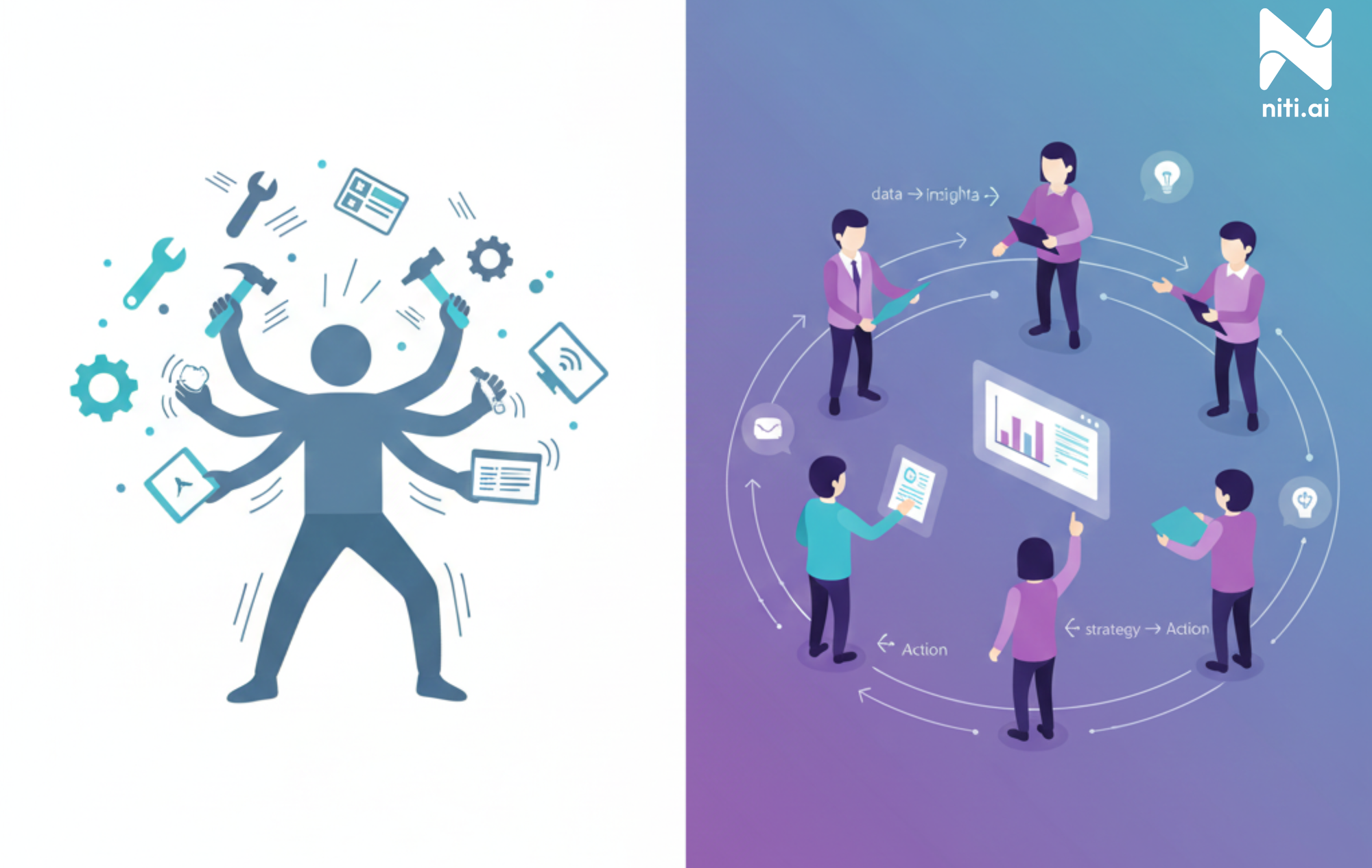
Your marketing team is three people doing the work of ten.
They're analysing customer data in spreadsheets. Building segments manually. Guessing at campaign strategies. Testing offers one at a time. Hoping something works before the next board meeting.
You've looked at solutions. Hightouch can optimize your campaigns. Klaviyo can automate your emails. Triple Whale can show you dashboards.
But here's what none of them do: They don't create the strategies. They don't replace the thinking.
You still need someone to figure out why customers are churning. Someone to decide which segments matter. Someone to design what offers preserve margin. Someone to generate how campaigns should work.
You still need to hire expensive strategists—if you can even find them.
This is where Hightouch and Niti AI diverge completely.
Hightouch sells you better tools. Niti AI becomes your team.
The Fundamental Difference: Tools vs. Workers
Let's be precise about what we're comparing:
Hightouch is a sophisticated AI-powered SaaS platform. It gives your marketing team better tools to execute faster—audience builders, journey orchestrators, real-time activation, AI agents that help with creative analysis and reporting.
Niti AI is a team of AI workers. Six autonomous agents that perform the complete jobs you're currently hiring humans to do—data analyst, growth strategist, segmentation specialist, offers manager, campaign planner, and performance optimizer.
This isn't semantic. It's categorical.
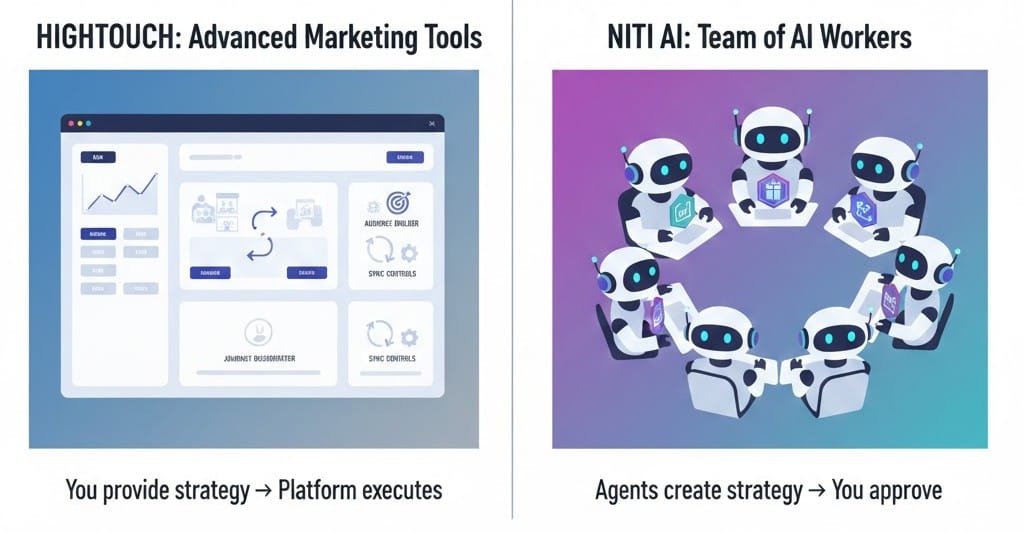
With Hightouch:
- You provide the strategy → Platform executes it
- You analyze the data → Platform activates it
- You design the offers → Platform optimizes delivery
- You build the segments → Platform syncs them
- You create the campaigns → Platform personalizes them
With Niti AI:
- Insights Agent analyzes the data → surfaces why customers behave
- Strategy Agent creates the campaigns → generates complete strategic options
- Segmentation Agent builds the audiences → defines precise targeting
- Offers Agent designs the economics → optimizes for margin preservation
- Playbook Agent produces execution plans → ready-to-launch briefs
- Performance Agent measures outcomes → regenerates improved strategies
The difference:
Hightouch assumes you have strategists who know what to do. It makes them more efficient.
Niti AI is the strategist. It does the thinking they would do.
Why This Matters: The Labor Economics Problem
Here's the uncomfortable truth about mid-market growth:
To run sophisticated retention marketing, you need:
The Roles:
- Data Analyst – Someone to query databases, analyze cohorts, identify patterns
- Growth Strategist – Someone to interpret insights, generate campaign ideas, design approaches
- Campaign Manager – Someone to build segments, write briefs, coordinate execution
- Performance Analyst – Someone to measure results, extract learnings, iterate strategies
The Reality:
- These roles cost $400K-500K/year in total compensation
- Each takes 3-6 months to hire (if you can find qualified candidates)
- Average tenure: 18-24 months before they leave
- Bottleneck: Even great strategists produce 2-3 campaigns per week maximum
- Overhead: Meetings, coordination, context-switching, vacations, sick days
The Mid-Market Trap:
Brands doing $2-50M in revenue can't afford this team. So they:
- Overwork their small team (burnout, turnover)
- Hire agencies (expensive, slow, misaligned incentives)
- Use basic automation (generic, not strategic)
- Let founders do it (not scalable, takes focus from growth)
This is the gap where platforms like Hightouch can't help.
Hightouch gives you better tools for the team you don't have.
The AI Workers Architecture
Niti AI approaches this differently. Instead of selling you a platform that requires strategic thinking, we built AI workers that do the strategic thinking.
Think of it like hiring a marketing team—except they're autonomous agents, not humans.
Meet Your AI Team
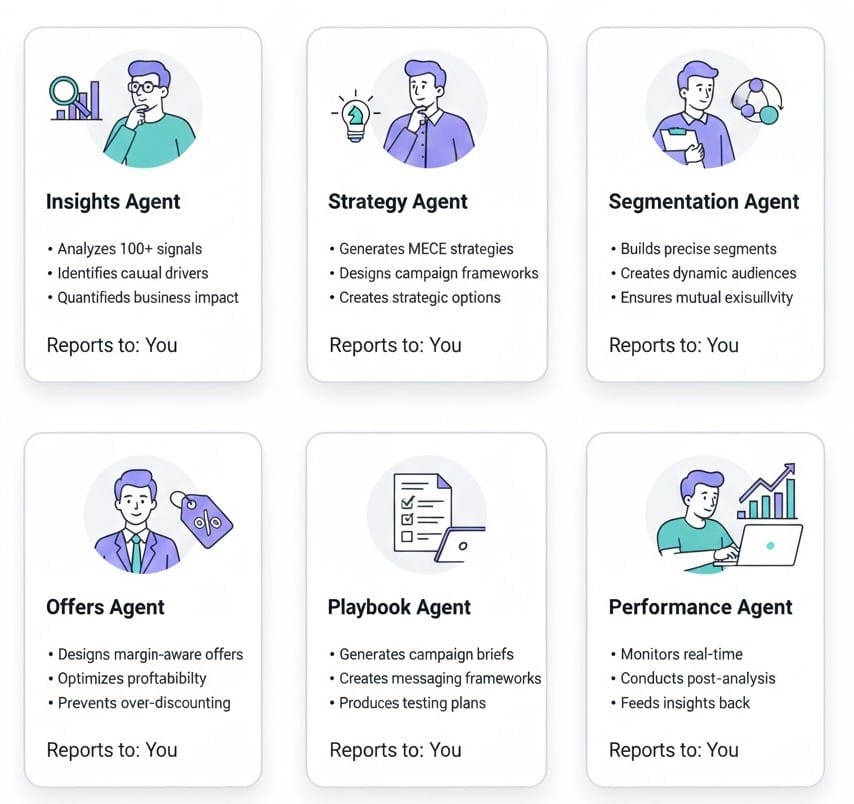
1. Insights Agent – Your Data Analyst
The Human Job It Replaces: Senior data analysts spend 15-20 hours per week querying databases, building cohort analyses, trying to understand customer behavior patterns.
What This Agent Does:
- Continuously monitors 100+ customer behavior signals
- Performs causal analysis, not just correlation ("customers churn because X, not just when Y happens")
- Identifies high-impact opportunities autonomously
- Surfaces insights like: "Customers who experienced delayed shipments are churning at 3x normal rates—this is costing you $47K/month in margin"
The Output: Natural language explanations of what's happening and why, with quantified business impact.
Human Equivalent: $120K/year data analyst AI Cost: Included in platform
2. Strategy Agent – Your Growth Strategist
The Human Job It Replaces: Growth strategists spend days brainstorming campaign approaches, designing strategic frameworks, deciding what to test.
What This Agent Does:
- Generates MECE (mutually exclusive, collectively exhaustive) campaign strategies
- Creates 3-5 distinct strategic options for different customer segments
- Designs approaches based on root cause analysis, not generic playbooks
- Considers business constraints, competitive context, seasonal factors
The Output: Complete strategic frameworks: "Strategy A: Operational Recovery for shipping-delayed customers. Strategy B: Activation Focus for incomplete-setup customers. Strategy C: Discovery Upsell for single-purchase customers."
Human Equivalent: $150K/year senior growth strategist AI Cost: Included in platform
3. Segmentation Agent – Your Audience Architect
The Human Job It Replaces: Analysts and marketers spend hours building segments in tools, testing definitions, sizing audiences.
What This Agent Does:
- Builds precise, multi-dimensional customer segments automatically
- Incorporates lifecycle stage, product affinity, margin contribution, price sensitivity
- Creates dynamic segments that evolve with behavior
- Ensures segments are mutually exclusive and actionable
The Output: Audience definitions ready to activate: "Segment 1: High-LTV customers with shipping issues (2,341 people, avg margin $87). Segment 2: Mid-tier incomplete-setup customers (5,892 people, avg margin $34)."
Human Equivalent: $100K/year segmentation specialist AI Cost: Included in platform
4. Offers Agent – Your Pricing Strategist
The Human Job It Replaces: Strategists guess at discount levels, test offers one at a time, often erode margins unnecessarily.
What This Agent Does:
- Designs margin-aware intervention strategies
- Optimizes offer structures for profitability, not just conversion
- Personalizes incentives by customer value and price sensitivity
- Prevents over-discounting through intelligent targeting
The Output: Offer strategies by segment: "High-LTV: No discount, offer expedited shipping credit ($15 cost, $150 margin preserved). Mid-tier: 10% off bundles only (increases AOV while maintaining margin). Price-sensitive: Strategic 15% discount (acceptable margin trade for retention)."
Human Equivalent: $130K/year retention/pricing specialist AI Cost: Included in platform
5. Playbook Agent – Your Campaign Manager
The Human Job It Replaces: Campaign managers spend days creating briefs, coordinating with creative, building execution plans.
What This Agent Does:
- Generates complete, execution-ready campaign briefs
- Produces detailed messaging frameworks and channel strategies
- Creates testing plans and success metrics
- Provides step-by-step implementation guidance
The Output: Campaign playbooks: "Segment 1 Campaign: Subject line variations (3 options tested), SMS follow-up timing (48 hours), channel sequence (email → SMS → push), success metrics (10% reactivation, 15% margin preservation)."
Human Equivalent: $110K/year campaign manager AI Cost: Included in platform
6. Performance Agent – Your Optimizer
The Human Job It Replaces: Analysts spend hours after campaigns pulling data, building reports, trying to figure out what worked.
What This Agent Does:
- Monitors campaign performance across all channels in real-time
- Conducts post-campaign analysis and learning capture
- Feeds insights back to other agents for strategy refinement
- Tracks margin impact and true ROI, not just engagement metrics
The Output: Learning summaries: "Strategy A achieved 12% reactivation at +$8 margin per customer (exceeded projection). Strategy B underperformed at 6% (shipping credit too generic—refine to product-specific credits). Strategy C successful: bundle upsells increased AOV 23%."
Human Equivalent: $90K/year performance analyst AI Cost: Included in platform
How The Workers Collaborate
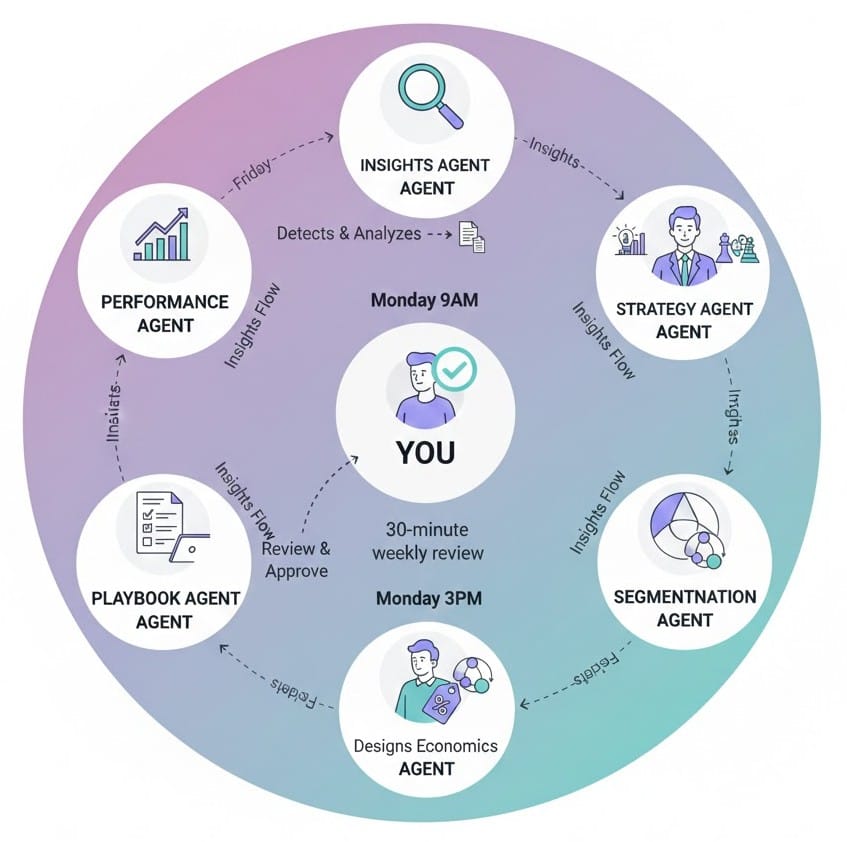
Like a real team, these agents don't work in isolation. They form an autonomous workflow:
Monday morning:
- Insights Agent detects churn spike in high-value cohort
- Performs causal analysis: delayed shipments + incomplete product setup = 3x churn
- Alerts Strategy Agent with quantified business impact
Monday afternoon: 4. Strategy Agent generates three distinct campaign approaches 5. Segmentation Agent builds precise audience definitions for each strategy 6. Offers Agent designs margin-preserving interventions tailored to each segment
Tuesday morning: 7. Playbook Agent creates complete execution briefs for all three campaigns 8. You review and approve (30-minute meeting, not 3-day project)
Tuesday-Thursday: 9. Your team executes in existing tools (Klaviyo, Shopify, etc.) 10. Performance Agent monitors results in real-time
Friday: 11. Performance Agent analyzes outcomes, identifies what worked 12. Feeds learnings back to all agents 13. Next week's strategies are 10-15% better based on this data
This happens every week. Continuously. Autonomously.
No meetings to coordinate. No waiting for analysis. No bottlenecks.
The Scenario: Tools vs. Workers in Action
Let's make this concrete. You notice churn spiking 15% in Q4 among your best customers.
With Hightouch (SaaS Platform Approach):
Week 1 – Human Analysis:
- Your analyst (if you have one) spends 3 days in SQL
- Builds dashboards, analyzes cohorts, identifies at-risk customers
- Creates "high churn risk" audience definition
- Syncs to Hightouch → Platform executes sync perfectly
Week 2 – Human Strategy:
- Your strategist (if you have one) reviews the data
- Brainstorms campaign approaches
- Decides on win-back strategy: "Send 20% discount to everyone at risk"
- This is where platform optimization begins
Week 2-3 – Hightouch AI Decisioning Optimizes:
- Hightouch's reinforcement learning personalizes delivery
- Tests which message variant works best per customer
- Optimizes send timing at 1:1 level
- Experiments with subject lines, content variations
Result after 30 days:
- ✓ Platform executed brilliantly (Hightouch's strength)
- ✓ 1:1 optimization improved engagement by 15%
- ✗ Strategy was generic: blanket 20% discount to all
- ✗ No root cause understanding (why are they churning?)
- ✗ High-value customers got unnecessary discounts (margin erosion)
- ✗ No differentiation by churn driver or customer value
- ✗ 2-3 weeks from detection to launch
Total cost: Platform ($5K/month) + Analyst ($10K/month) + Strategist ($12K/month) = $27K/month
What Hightouch optimized: Execution and delivery What still required humans: Analysis, strategy, segmentation, offer design
With Niti AI (AI Workers Approach):
Monday 9 AM – Insights Agent Analyzes (2 hours, autonomous):
- Detects churn spike automatically
- Performs causal analysis across 100+ features
- Discovers root causes:
- Delayed shipments → 3.2x churn rate (affecting 2,341 customers)
- Incomplete product setup → 2.8x churn rate (affecting 5,892 customers)
- Single-item purchases → 2.1x churn rate (affecting 8,105 customers)
- Quantifies margin impact: $47K/month in lost revenue
Monday 11 AM – Strategy Agent Generates (1 hour, autonomous):
Strategy A: "Operational Trust Recovery"
- Target: Customers with delayed shipment experience
- Root cause: Lost trust in reliability
- Approach: Proactive service recovery + reliability guarantee
Strategy B: "Activation Acceleration"
- Target: Customers with incomplete product setup
- Root cause: Low product stickiness
- Approach: Guided setup + feature unlocking
Strategy C: "Discovery Expansion"
- Target: Single-item purchasers
- Root cause: Limited value realization
- Approach: Strategic bundle recommendations
Monday 12 PM – Segmentation Agent Builds (30 min, autonomous):
- Segment 1: 2,341 high-LTV shipping-delayed customers
- Segment 2: 5,892 mid-tier incomplete-setup customers
- Segment 3: 8,105 price-sensitive single-item buyers
Monday 1 PM – Offers Agent Designs (1 hour, autonomous):
For Segment 1 (High-LTV + Shipping Issues):
- NO discount (would train bad behavior)
- Expedited shipping credit ($15 cost)
- Direct account manager check-in
- Early access to new products
- Margin impact: Positive ($150 retention value >> $15 cost)
For Segment 2 (Incomplete Setup):
- Personalized setup consultation (high-touch)
- Feature progression system
- Success milestone rewards (non-monetary)
- Margin impact: Positive (no discounting, increased activation)
For Segment 3 (Single-Item Buyers):
- Smart bundle recommendations (complementary products)
- "Complete the set" 10% discount on bundles only
- Product discovery quiz
- Margin impact: Positive (bundle AOV increase > discount cost)
Monday 2 PM – Playbook Agent Produces (1 hour, autonomous):
- Complete campaign briefs for all three strategies
- Messaging frameworks customized to each segment
- Channel orchestration (email + SMS + push sequences)
- Testing plans and success metrics
Monday 3 PM – You Review (30 minutes):
- All six agents have completed their work
- You see three complete, execution-ready strategies
- You approve all three (or modify based on business context)
Monday 4 PM – Tuesday:
- Your team executes in Klaviyo/existing tools (build time only, zero strategy time)
- Campaigns launch 24 hours after churn detection
Days 2-30 – Performance Agent Monitors:
- Tracks margin impact, not just engagement
- Identifies Strategy A performing best (14% reactivation, +$11 margin)
- Strategy B moderate success (8% reactivation, +$6 margin)
- Strategy C exceeding projections (19% bundle adoption, +$18 margin)
- Feeds learnings back to all agents for next week's strategies
Result after 30 days:
- ✓ Churn reduced by 13% (better than generic approach)
- ✓ Margin increased by 9% (smart, targeted interventions)
- ✓ Root cause understanding (shipping, setup, single-item patterns documented)
- ✓ Differentiated strategy by segment and churn driver
- ✓ 1 day from detection to campaign launch
- ✓ Continuous improvement (each week's strategies better than last)
Total cost: $4K/month (all six AI workers included)
What AI Workers did: Complete end-to-end strategy generation, analysis, segmentation, offer design, and playbook creation What still required humans: 30-minute approval, campaign build execution
This Is The Difference
Let's be explicit about what just happened:
Hightouch's platform worked beautifully. It synced audiences, optimized delivery, personalized at 1:1 scale. The infrastructure performed flawlessly.
But someone still had to:
- Figure out why customers were churning (human analyst)
- Generate the campaign strategies (human strategist)
- Decide on the offer approach (human guess)
- Build the segments (human in UI)
- Design the playbooks (human campaign manager)
That's because platforms don't think. They execute what you tell them to do.
Niti AI's six AI workers did all of that strategic thinking:
- Insights Agent identified causal drivers
- Strategy Agent generated three distinct approaches
- Segmentation Agent built precise audiences
- Offers Agent designed margin-aware interventions
- Playbook Agent produced execution briefs
- Performance Agent measured and learned
This is the difference between tools and workers.
Tools make your team more efficient. Workers replace the need for the team.
The Labor Transformation
Here's what makes this a category shift, not just a feature difference:
The Hiring Problem
Mid-market brands face impossible hiring economics:
To Hire:
- Growth Strategist: $150K/year + 4-6 months to find + 3 months to ramp
- Data Analyst: $120K/year + 3-4 months to find + 2 months to ramp
- Campaign Manager: $110K/year + 3-4 months to find + 2 months to ramp
Total: $380K/year in compensation + 12-18 months to build the team + turnover risk (18-24 month average tenure)
And even then:
- Team produces 2-3 strategies per week maximum
- Coordination overhead (meetings, context-switching)
- Vacation, sick days, competing priorities
- Bottlenecks when someone leaves
The Platform Trap
Platforms like Hightouch say: "We'll make your team more efficient!"
But for mid-market brands, the team doesn't exist. You can't make zero people 10x more efficient.
You can give founders better tools—but founders shouldn't be building marketing segments. They should be running the business.
The AI Workers Solution
Niti AI replaces the labor entirely:
Output:
- 10+ strategies per week (vs. 2-3 from human team)
- Strategies generated in hours (vs. days)
- Continuous operation (24/7, no vacations)
- Instant scaling (same cost whether you run 5 campaigns or 50)
Cost:
- $50K/year for complete AI worker team
- 1/8th the cost of human team
- Zero hiring friction
- Zero turnover risk
Quality:
- Consistent (no "off days")
- Data-driven (analyzes 100+ features humans can't process)
- Margin-aware (optimizes for profit, not just engagement)
- Learning (gets better every week)
This is labor transformation, not labor augmentation.
What Hightouch Does Exceptionally Well
Let's be intellectually honest about where Hightouch excels:
1. Enterprise Data Infrastructure
- 300+ integrations across marketing, data, and business tools
- Works with any data warehouse (Snowflake, Databricks, BigQuery, Redshift)
- Enterprise-grade governance, compliance, security controls
- Multi-region deployment, SOC 2, ISO certifications
2. Execution Scale
- Battle-tested at massive scale (70M+ loyalty members for PetSmart)
- Real-time data activation with sub-second latency
- Sophisticated identity resolution across devices and platforms
- Robust sync monitoring, error handling, observability
3. 1:1 Optimization Maturity
- Advanced reinforcement learning for personalization
- Proven AI Decisioning with customer logos (WHOOP, PetSmart)
- Contextual bandits and multi-armed bandits in production
- Experimentation framework at individual customer level
4. Brand & Funding
- $1.2B valuation, $80M Series C (2025)
- Investment from both Snowflake and Databricks
- Established category leader in Composable CDP
- Strong customer logos (Spotify, Grammarly, Domino's)
These are real strengths. If you're an enterprise brand with a data engineering team and sophisticated campaign strategies, Hightouch is exceptional at optimizing execution.
What Niti AI Does That Hightouch Doesn't
1. Strategy Generation (Not Just Optimization)
- Hightouch: Takes your campaign and optimizes which variant to send
- Niti AI: Creates the campaign strategy from scratch based on customer analysis
2. Causal Reasoning (Not Just Correlation)
- Hightouch: Learns "Message A works better than Message B" (correlational RL)
- Niti AI: Explains "Customers churn because delayed shipments break trust" (causal reasoning)
3. Margin-Aware Optimization
- Hightouch: Optimizes for engagement, clicks, conversions (marketing metrics)
- Niti AI: Optimizes for retained margin, profit contribution (financial metrics)
4. Complete Workflow Replacement
- Hightouch: Requires strategist + analyst to feed it strategies
- Niti AI: The strategist and analyst are built in (AI workers)
5. Mid-Market Focus
- Hightouch: Enterprise platform requiring data warehouse, engineering resources
- Niti AI: Shopify-native, works without data warehouse or data team
The Market They Serve vs. The Market We Serve
This isn't really a competitive situation. We serve fundamentally different customers.
Hightouch's Ideal Customer:
Profile:
- Enterprise brands ($100M+ revenue)
- Has data warehouse (Snowflake, Databricks)
- Employs data engineering team
- Already has 5+ marketing strategists
- Needs to optimize execution at massive scale
Use Case: "We have sophisticated campaign strategies and a team creating them. We need infrastructure to execute at 70M+ customers with 1:1 personalization."
Buying Process:
- 6-12 month sales cycle
- IT/Data team heavily involved
- Enterprise procurement (security reviews, legal, multi-team approvals)
Price Point: $50K-200K+/year
Example Customers: Spotify, PetSmart, Grammarly (established brands with resources)
Niti AI's Ideal Customer:
Profile:
- Mid-market DTC brands ($2-50M revenue)
- Uses Shopify + Klaviyo/basic tools
- No data warehouse, no data team
- 0-2 marketing strategists (often just founder + coordinator)
- Needs strategies created, not just optimized
Use Case: "We don't have strategists. We need someone to analyze why customers churn, generate campaign ideas, and tell us what offers to send—optimized for profit, not just conversions."
Buying Process:
- 2-4 week sales cycle
- CMO/Founder decision (sometimes CFO involved due to cost savings)
- Quick POC, fast results needed
Price Point: $15K-50K/year
Example Customers: Growing Shopify brands, quick commerce, D2C startups (resource-constrained, scaling fast)
The Overlap Is Narrow
There's a small overlap—mid-market brands who might consider both:
For them, the question is:
"Do you need better tools for your existing team, or do you need to replace the team you can't afford to hire?"
If you have strategists who create campaigns, Hightouch optimizes execution.
If you don't have strategists, Niti AI becomes your strategists.
Can They Work Together?
Yes. For sophisticated brands, the answer isn't Hightouch OR Niti AI—it could be both.
The Integration Model:
1. Niti AI generates the strategies:
- Six-agent system identifies opportunities
- Creates campaign strategies with margin-aware offers
- Builds precise audience definitions
- Produces execution-ready playbooks
2. Hightouch executes at enterprise scale:
- Syncs those audiences to every destination
- Handles real-time updates as behavior changes
- Ensures reliable delivery across complex infrastructure
- Provides enterprise governance and monitoring
3. Niti AI optimizes the strategies:
- Performance Agent tracks margin impact
- Analyzes what's working, what's not
- Regenerates improved strategies weekly
- Feeds learnings back for continuous improvement
4. Hightouch ensures reliable delivery:
- Updated audiences flow to destinations automatically
- No manual segment rebuilds
- Infrastructure scales as strategy complexity grows
The Symbiosis:
Enterprise infrastructure (Hightouch) + Strategic intelligence (Niti AI)
One provides the pipes. The other provides the brain.
But—and this is critical—most mid-market brands don't need Hightouch's enterprise infrastructure. Niti AI integrates directly with Shopify, Klaviyo, BigQuery, and standard tools. For the typical $2-50M brand, adding Hightouch adds complexity and cost without proportional value.
The Category Creation Moment
Here's what makes this comparison fascinating:
Hightouch and Niti AI aren't really competitors. They created different categories.
Hightouch Created: "Composable CDP"
The Problem They Solved: "Traditional CDPs are expensive, inflexible black boxes. What if your data warehouse could be your CDP?"
Their Category: Data activation platform for enterprises
Their Innovation: Warehouse-native architecture, reverse ETL, composable approach
Their Market: Enterprise brands modernizing data infrastructure
Niti AI Is Creating: "AI Workers for Growth"
The Problem We're Solving: "Mid-market brands can't afford $400K in strategist salaries, but platforms assume you have those strategists."
Our Category: Autonomous AI workers that replace marketing labor
Our Innovation: Complete role replacement via specialized agent architecture
Our Market: Mid-market brands who need strategy generated, not just executed
Different Value Propositions:
Hightouch's promise: "Replace your traditional CDP with modern data warehouse-native infrastructure that gives your team better execution capabilities."
Niti AI's promise: "Replace the expensive growth strategist you can't hire with AI workers that generate better strategies for 1/10th the cost."
One is about infrastructure evolution. The other is about labor transformation.
Different problems. Different buyers. Different futures.
The Real Question: What Does Your Business Need?
Strip away the features, the technical architecture, the vendor positioning.
Ask yourself one honest question:
"What's preventing us from running sophisticated retention marketing?"
If your answer is: "We have great strategists, but our data infrastructure is holding us back" → You need Hightouch
Your team knows what campaigns to run. They understand customer behavior. They have strategic frameworks. But data is stuck in silos. Segments take days to sync. You're manually uploading CSVs. You need better infrastructure.
Solution: Hightouch provides world-class data activation.
If your answer is: "We don't have strategists. We don't know what campaigns to run or why customers are leaving" → You need Niti AI
Your data flows fine. But nobody knows what to do with it. The founder is guessing at strategies. You're copying competitors' playbooks. You want to hire a strategist but can't find one (or can't afford the $150K). You need strategic intelligence.
Solution: Niti AI provides AI workers who do the strategic thinking.
If your answer is: "We're enterprise-scale with complex needs across both infrastructure and strategy" → You might need both
You have sophisticated requirements: governance, compliance, multi-brand, global scale. You need enterprise infrastructure AND strategic intelligence working together.
Solution: Hightouch + Niti AI integrated.
The Honest Truth for 80% of DTC Brands:
They're not failing because their data pipes are slow.
They're failing because creating great retention strategies requires skills they don't have and can't afford to hire.
They have enough infrastructure for their scale. They need intelligence.
They have enough tools. They need thinking.
They have enough platforms. They need workers.
The Paradigm Shift
Ten years from now, we'll look back at 2024 and find it strange:
We built billion-dollar infrastructure companies to move data faster—but still relied on humans working 40-hour weeks to figure out what to do with that data.
We automated the pipes. We left the thinking to humans.
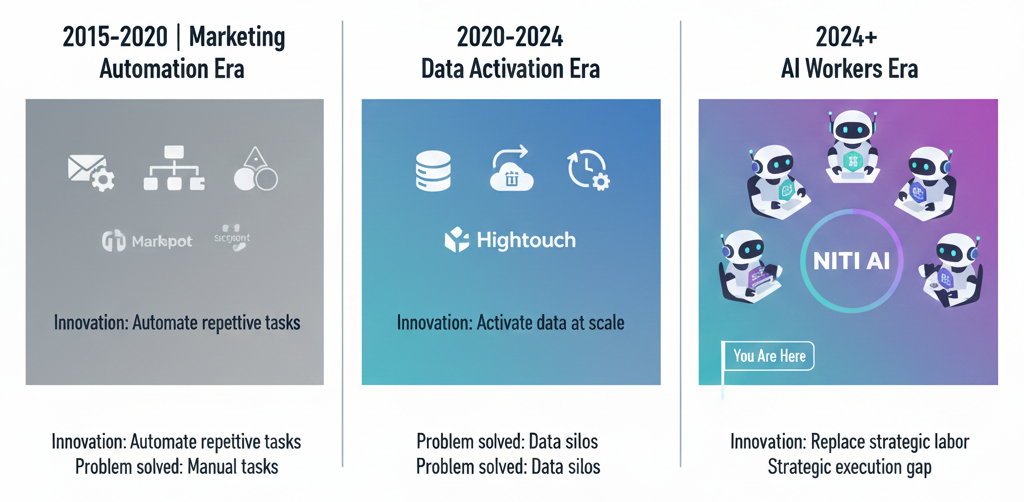
The Infrastructure Era (2020-2024)
Hightouch represents the pinnacle of this paradigm.
They solved a critical problem: modern, composable, warehouse-native data activation. They did it brilliantly. They won their category decisively.
But infrastructure was always a means, not an end.
The point of moving data isn't the movement—it's the decisions. The strategies. The outcomes.
The AI Workers Era (2024+)
Niti AI represents the next paradigm: Autonomous strategic intelligence delivered as workers, not tools.
Not platforms that help humans work faster. Not dashboards that surface insights for humans to interpret. Not automation that executes what humans define.
AI workers that perform the complete strategic roles humans used to do.
- The Insights Agent that analyzes causality (replacing data analysts)
- The Strategy Agent that generates approaches (replacing growth strategists)
- The Segmentation Agent that builds audiences (replacing segmentation specialists)
- The Offers Agent that optimizes economics (replacing pricing strategists)
- The Playbook Agent that creates execution plans (replacing campaign managers)
- The Performance Agent that learns and improves (replacing optimization analysts)
This is the future: Infrastructure that moves data + Workers that decide what to do with it.
Why "AI Workers" Changes Everything
This isn't just positioning—it's a fundamental rethinking of what we're buying.
The Old Mental Model: "Buy Software"
- Evaluate features
- Compare integrations
- Calculate per-seat pricing
- Implement (6-12 months)
- Train team to use it
- Pay forever
Result: You have a tool. You still need people to use the tool effectively.
The New Mental Model: "Hire Workers"
- Evaluate what job needs doing
- Compare output quality
- Calculate cost vs. human salary
- Onboard (2 weeks)
- Workers learn your business
- Pay for results
Result: You have a team. The workers do the job, you review the output.
Why This Matters for Buyers:
Software Buying Process:
- IT involved (security, compliance, integrations)
- Long evaluation (compare 5+ platforms)
- Feature checklists
- Proof of concept (does the tool work?)
Labor Buying Process:
- Business leader decides (can this role be filled?)
- Fast evaluation (can they do the job?)
- Output-focused (show me the work)
- Trial period (is the quality good enough?)
The psychology is completely different.
When you "hire" AI workers, you evaluate them like you'd evaluate a new employee:
- Can they do the analysis I need?
- Are their strategies any good?
- Do they understand my business?
- Are they worth the cost vs. a human?
When you "buy" software, you evaluate features:
- Does it integrate with my stack?
- What's the pricing model?
- How long to implement?
- What does IT think?
We're selling labor replacement, not software.
That's why this positioning works.
The Proof: What Good Looks Like
Here's how you know if this positioning is real or just marketing:
A Platform/Tool:
Demo shows you:
- UI screenshots
- Feature lists
- Integration possibilities
- Dashboard examples
Trial period tests:
- Can you navigate the interface?
- Do the syncs work?
- Are the reports accurate?
Success looks like:
- Tool is implemented
- Team is trained
- Platform is being used
AI Workers:
Demo shows you:
- Actual strategy the agents generated
- Complete analysis with causal reasoning
- Margin-aware offer recommendations
- Execution-ready campaign briefs
Trial period tests:
- Are the strategies any good?
- Do they understand your business context?
- Are the insights actionable?
- Does the output match or beat human quality?
Success looks like:
- Strategies are being approved
- Campaigns are launching
- Results are measurable
- You're running more campaigns than before
The difference:
With tools, you evaluate whether the software works. With workers, you evaluate whether the output is good.
Niti AI must be evaluated as workers, not as software.
If our agents don't generate strategies as good as (or better than) what a human strategist would create, we've failed—regardless of how nice our UI is.
Ready to Hire Your AI Growth Team?
The era of "better tools for overworked humans" is ending.
The era of "AI workers who replace expensive labor" is here.
Hightouch is exceptional at what it does: Enterprise-grade infrastructure for brands with strategic resources.
Niti AI does something different: We become the strategic resources you don't have.
The question isn't which platform is "better."
The question is: Do you need better tools, or do you need workers?
If you're a $2-50M brand who:
- Can't afford or can't find a $150K growth strategist
- Spends hours analyzing data without clear strategic direction
- Runs generic campaigns because you don't have time for sophisticated strategies
- Wants to optimize for profit, not just engagement
- Needs 10+ strategies per week, not 2-3
[Schedule a demo] to meet your AI growth team. Watch our agents analyze your business, generate strategies, and produce execution-ready campaigns—just like the strategists you wish you could hire.
Or keep looking for platforms that assume you have a team you don't.
The future of marketing isn't better tools for humans.
It's AI workers that replace the need for those humans entirely.
Welcome to the AI Workers era.