
Decision Models for Marketing: Workflows for CEOs, CFOs, CMOs and Performance Marketers
Step-by-step workflows showing which decision models CEOs, CFOs, CMOs and performance marketers use, which they skip, and where each step fits.
Most advice about AI in marketing starts with the tool. This guide starts with the questions. Each role in a marketing business asks different questions, on different schedules, and needs a different model to answer them. Some questions need no model at all.
We follow one event through all four roles so you can see how the same signal lands differently. Then we walk through each role's workflow step by step, marking which model runs at each step and which models stay out of it.
If you haven't read the explainer yet, start with What Is Jev? A Practical Guide to Decision Models for Marketing. It covers the five types of decision modeling in detail. This post applies them to people.
One event, four views
The event: On Tuesday, a skincare brand updates its checkout page. By Thursday, purchase events in the ad platform are arriving intermittently. The agency's review note mentions the checkout change in passing.
| Role | What they see on Thursday | What they do next |
|---|---|---|
| CEO | A digest line: "3 accounts flagged for measurement changes, 2 holds active" | Asks whether any board numbers depend on the affected week |
| CFO | The week's revenue is down, and the return on the affected campaigns looks worse | Checks whether the immature cohort is counted in the return before deciding anything |
| CMO | A ranked queue where "tracking change" sits first, ahead of creative fatigue | Assigns the investigation and holds creative tests on the affected account |
| Performance marketer | A rule has paused budget increases on the account, and a note has been flagged | Confirms the event logs, then restores budgets once tracking is fixed |
Same event. Four different jobs. The rest of this post shows how each job is built.
The shared setup
Five models, defined once
Every workflow below uses some combination of these five models. Learn them here and the persona sections will be quick to read.
| Model | The question it answers | What goes in | What comes out | Example from this post |
|---|---|---|---|---|
| Decision model (Jev-style) | Which answer fits this text? | Agency note, change log, or review text, plus your written question and answers | A typed judgment with a probability for each option | "Does this note report a measurement change?" returns yes 0.91 |
| Rules | Has this number crossed a line? | Structured fields such as budget, stock, and status | Yes or no, plus the action the rule triggers | "Budget changed by more than 20%" pauses increases |
| Causal model (MMM or lift test) | What did spend cause? | Weeks or months of spend and sales data, and any lift test results | A range of return per channel, with the assumptions written down | Channel ROI between 1.4x and 2.1x |
| Optimizer | Which budget split is best within our limits? | Response curves, spend caps, and margin floors | A proposed split that stays inside the limits | A split across three channels under a daily cap |
| Bandit | Which option should get the next impression? | Fast feedback on each option, such as daily clicks or conversions | A shift of traffic toward options that are doing better | Rotating creatives on daily paid social |
We also name one model here that doesn't appear in any workflow: a predictive forecasting model for next quarter's revenue. It's useful for planning, but none of the workflows below needs it, so you'll see it marked as not used.
The four-step pattern
Every workflow in this post runs the same four steps. The roles differ in which step they own and how often they run it.
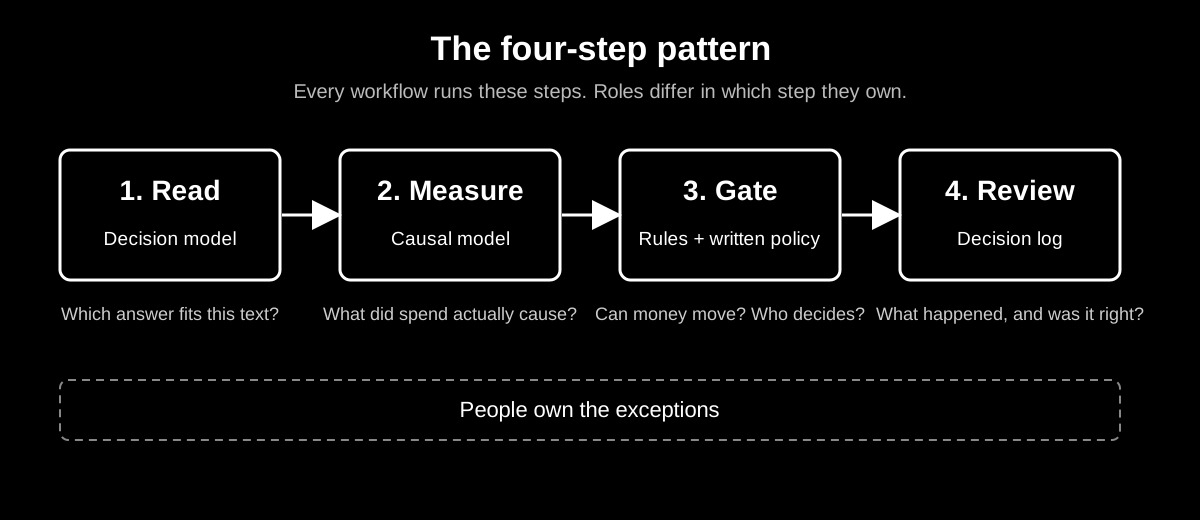
- Read. A decision model turns text into typed judgments: what the note says, what cause fits, what cohort is mature.
- Measure. A causal model estimates what spend actually did, as a range.
- Gate. A written policy decides whether money can move. Rules enforce it. People handle exceptions.
- Review. A decision log records every judgment and action, so anyone can check what happened later.
How to read the tables
In the persona sections, each model gets one of three marks:
- ✓ Used at this step
- ◐ Used only under a condition, which is written next to it
- ✗ Not used here, with the reason
CEO: "Is any of our spend running on bad data?"
The job. The CEO doesn't review campaigns. The CEO needs to know whether marketing money is safe, whether any decision was made on broken data, and whether the numbers in the board deck can be trusted.
Questions the CEO asks
| Question | How often | Model support |
|---|---|---|
| Is any spend running on broken data? | Weekly, and when something looks off | ✓ Decision model flags, rule holds |
| Did the quarter's marketing money earn its return? | Quarterly | ✓ Causal model gives a range |
| Can we trust the number in the board deck? | Ad hoc, before board meetings | ◐ Only if the decision log and the return range are shown with their assumptions |
| Should the budget mix change for next year? | Annually | ✗ Not from these models. That's the CFO's envelope plus an optimizer. |
The CEO's workflow
| Step | When | What happens | Model | Output the CEO sees |
|---|---|---|---|---|
| 1 | Weekly | Agency notes are read | ✓ Decision model: yes, no, or unclear on "measurement changed" | Flagged accounts, with probabilities |
| 2 | Weekly | A flag has been open more than 7 days | ✓ Rule | Escalation onto the CEO's list |
| 3 | Quarterly | Return by channel is estimated | ✓ Causal model | Return range per channel, assumptions listed |
| 4 | Monthly | The decision log is reviewed | No model, a human reads it | Count of budget moves made while a flag was open |
What the CEO does not use
- A decision model for return. It can flag a measurement problem, but it can't estimate what spend caused. ✗
- An optimizer. The CEO sets direction, not the split. ✗
- A bandit. Creative tests are too granular for this level. ✗
Worked output (illustrative)
Weekly digest, week 44
3 accounts flagged for measurement changes. 2 holds active.
Checkout tracking flag: open 4 days, owner: performance lead.
Decision needed from you: none yet.
Budget moves made while a flag was open: 0.
Metric to track: budget moves made while a measurement flag was open. The target is zero.
Where it breaks: the CEO reads the digest but never the rule behind it. If the policy is vague, the flags become decoration.
CFO: "Why didn't the spend turn into revenue, and can I trust the return?"
The job. The CFO approves budgets. The CFO needs the return to be real, spend to stay inside agreed limits, and a clear answer when revenue misses.
Questions the CFO asks
| Question | How often | Model support |
|---|---|---|
| Why didn't spend turn into revenue? | Monthly, or when revenue misses | ◐ Decision model ranks candidate causes from evidence. A causal model sizes them. |
| Is the return we approved real? | Monthly | ✓ Causal model gives a range |
| Are we inside the spend envelope? | Weekly | ✓ Rules |
| Which cohorts count toward return yet? | Weekly | ✓ Decision model: mature, immature, or unclear |
| What's the budget split for next quarter? | Quarterly | ◐ Optimizer, only inside the envelope the CFO set |
The CFO's workflow
| Step | When | What happens | Model | Output the CFO sees |
|---|---|---|---|---|
| 0 | Quarterly | CFO sets the envelope: daily caps per campaign, hold rules, and the outcome window | No model, a human decision | Signed envelope |
| 1 | Weekly | Each cohort is judged mature or immature | ✓ Decision model, rating or choice | Immature cohorts excluded from return |
| 2 | Weekly | Spend is checked against the envelope | ✓ Rules | Alert if any campaign passes 90% of its cap |
| 3 | Monthly | Return range by channel is updated | ✓ Causal model, with lift tests as priors | Return range by channel |
| 4 | Monthly, when revenue misses | Candidate causes are ranked from the evidence | ◐ Decision model, choice question over causes. It reads text evidence, not the revenue number. | Ranked causes with probabilities |
| 5 | After step 4 | The top cause is checked against the event logs | No model. Jev can't verify facts, so people check the logs. | Confirmed or rejected |
| 6 | Quarterly | Proposed budget split | ◐ Optimizer, inside the envelope. Anything outside goes to a person. | Split, with limits shown |
Worked example: the "why no revenue" question
The CFO asks why spend went up 30% and revenue stayed flat. The CFO doesn't ask the model for the answer. The CFO asks it to rank the causes, using only the text evidence: agency notes, the checkout change log, and the inventory summary.
| Candidate cause | Probability from the decision model |
|---|---|
| Tracking or measurement change | 58% |
| Stock-out during peak weeks | 22% |
| Creative fatigue | 9% |
| Platform over-claiming | 5% |
| Inconclusive | 6% |
A 58% probability means "check tracking first." It does not mean "tracking broke." Before anyone acts on it, the CFO asks four questions: does the model's 58% answers match past accuracy at that level (calibration), does the evidence text mention the change, do the event logs confirm it, and does the answer hold when the question is worded differently. The full checklist is in the how-to section of the explainer.
What the CFO does not use
- A decision model for sizing the gap. It can rank causes but can't estimate how much each one cost. ✗
- A bandit for the budget mix. Monthly budget decisions have feedback that arrives too slowly to learn from. ✗
- A predictive model here. Forecasting belongs in planning, not in this monthly return review. ✗
Metric to track: share of spend inside the envelope, and the gap between reconciled return and the model's range. A gap that keeps widening means the assumptions need work.
Where it breaks: a marketing mix model is only as good as its assumptions, and they may not hold for every brand. Ask which assumptions the model makes, not only what the output says.
CMO: "Which of 40 campaigns need action this week?"
The job. The CMO decides where the team's attention goes. The problem is volume. No one can read every note, so the important ones get missed until they show up in the numbers.
Questions the CMO asks
| Question | How often | Model support |
|---|---|---|
| Which campaigns need action this week? | Weekly | ✓ Decision model (cause and flags), then rules for priority |
| Which creatives are tiring? | Weekly | ✓ Decision model, rating from 1 to 5 |
| Which creative should we test next? | Monthly | ◐ Bandit only where feedback arrives within days. Otherwise a fixed holdout test. |
| What's driving this account's drop? | Ad hoc | ◐ Decision model ranks candidate causes. The team checks them. |
| Should spend move between channels? | Quarterly | ✗ Needs the causal model and the CFO's envelope, not these weekly tools |
The CMO's workflow
| Step | When | What happens | Model | Output the CMO sees |
|---|---|---|---|---|
| 1 | Weekly | Every review note is read | ✓ Decision model: flags and creative-fatigue rating | Flags and ratings per campaign |
| 2 | Weekly | Flagged accounts are sorted by likely cause | ✓ Decision model, choice question | Cause probabilities |
| 3 | Weekly | Items are ranked by priority | ✓ Rules: tracking first, then stock, then fatigue | Ranked queue |
| 4 | Weekly | The team works the top 10 items | No model, a human action | Actions logged |
| 5 | Monthly | A creative test runs | ◐ Bandit for paid social with daily feedback. Holdout test otherwise. | Winner with confidence |
| 6 | Quarterly | Channel shift is considered | ✗ Handed to the CFO's envelope and a causal model | Not decided here |
Worked output: the weekly queue (illustrative)
| Rank | Item | Model reading | Action |
|---|---|---|---|
| 1 | Checkout tracking | Tracking change: 0.91 | Investigate today |
| 2 | Stock on one SKU group | Stock constraint: 0.62 | Route to merchandising |
| 3 | Two ad sets with tired creative | Fatigue rating: 4 of 5 | Rotate creatives this week |
What the CMO does not use
- A causal model every week. It's too slow for weekly decisions. Use it quarterly. ✗
- An optimizer at this level. The optimizer works inside the CFO's envelope. ✗
- A decision model for return. It ranks causes, not return. ✗
Metric to track: time from flag to decision, and missed flags found in a weekly audit of a random sample of notes the model marked "no."
Where it breaks: notes written inconsistently. When the team changes how it writes notes, the definitions drift. Rerun the labeling check every quarter.
Performance marketer: "Which ad sets are wasting money today?"
The job. The performance marketer watches ad sets daily, catches waste early, and needs to know whether the numbers in front of them can be trusted.
Questions the performance marketer asks
| Question | How often | Model support |
|---|---|---|
| Which ad sets are wasting money today? | Daily | ✓ Rules on structured numbers |
| Did this change break tracking? | When a change is logged | ✓ Decision model on notes, confirmed in event logs |
| Which creative should get more budget? | Daily | ◐ Bandit, inside a daily cap |
| Is the platform's reported number real? | Weekly | ✗ Not from a decision model. Use a holdout test or a lift test. |
The performance marketer's workflow
| Step | When | What happens | Model | Output |
|---|---|---|---|---|
| 1 | Daily | Structured rules run | ✓ Rules: budget change over 20%, stock under 10 units, paused without a note | Alerts |
| 2 | Daily | Notes are judged | ✓ Decision model. Shadow mode first: it flags but doesn't act. | Flags, logged |
| 3 | Daily | Creatives are rotated | ◐ Bandit, only inside a daily budget cap | Budget shifted up to the cap |
| 4 | Weekly | A labeled sample is checked | No model. A human compares it to the model's answers. | Disagreement rate |
| 5 | Weekly | Question wording is updated if needed | No model. A human rewrites the question. | Updated definition |
Worked output (illustrative)
Ad set 14, Thursday
Note: "Promotion ended Sunday. Two variants are unavailable. Purchase events intermittent after checkout update."
Model: "promotion ended" 0.94
Rule: budget increases on ad set 14 are held until the promotion is confirmed live.
Logged for review.
What the performance marketer does not use
- A causal model for daily work. Too slow and too broad for daily ad set decisions. ✗
- An optimizer across channels. That belongs to the CFO's envelope. ✗
- A forecasting model. The daily job is to catch waste, not to predict next week. ✗
Metric to track: agreement with human labels, false alarms per week, and hours saved on manual note review.
Where it breaks: automating too fast. A bad definition fails the same way on every ad set, every week. Keep the model in shadow mode until the error rates hold.
Side by side: which models each role uses
| Model | CEO | CFO | CMO | Performance marketer |
|---|---|---|---|---|
| Decision model | ✓ Flags | ✓ Cohorts, causes | ✓ Flags, cause, fatigue | ✓ Notes, in shadow mode first |
| Rules | ✓ Escalation | ✓ Envelope | ✓ Priority queue | ✓ Daily alerts |
| Causal model | ✓ Quarterly return | ✓ Monthly return | ◐ Quarterly only | ✗ |
| Optimizer | ✗ | ◐ Inside envelope | ✗ | ✗ |
| Bandit | ✗ | ✗ | ◐ Fast-feedback creatives | ◐ Inside daily cap |
| Predictive forecast | ✗ | ✗ | ✗ | ✗ |
The predictive forecast row is empty on purpose. Forecasting is useful for planning. None of these four weekly-and-monthly workflows depends on it.
Start this week
Pick one role and the one question that person asks every week. Write the question and its answers, including "unclear." Have two people label 100 past cases. Run the model in shadow mode for two weeks. Check the disagreements before it touches a budget.
Whichever role you start with, the rule matters more than the model. Write it down, name an owner, and log every decision it covers.
Related reading
- What Is Jev? A Practical Guide to Decision Models for Marketing
- Google, Meridian documentation on causal inference for marketing mix models: https://developers.google.com/meridian/docs/causal-inference/rationale-for-causal-inference-and-bayesian-modeling
- Cisco Blogs, "Jev: Decision Models on Trial," October 5, 2026: https://blogs.cisco.com/ai/jev-decision-models-on-trial
- Weng et al., "Our Own Jev," arXiv:2610.29052: https://arxiv.org/abs/2610.29052
- "When Offline Evaluation Misleads," arXiv:2608.11560: https://arxiv.org/abs/2608.11560
- Anthropic, research post on using Claude to formally verify open-source software, 2026: https://www.anthropic.com/research/formal-verification
Jev is a product of TypeSafe AI. This guide is independent analysis. Niti AI is not affiliated with TypeSafe AI.