Beyond Marketing Automation: Why Growing D2C Brands Are Replacing Klaviyo with Agentic Growth Strategists

The $150,000 Question Every CMO Is Asking
You're spending $300 to $1,500 monthly on Klaviyo. Your team logs countless hours analyzing cohorts, building segments, and designing campaigns. You're drowning in data but starving for strategy. And after all that effort, your discount campaigns are eroding margins while 70% of customer lifetime value vanishes to churn. For a hands-on playbook on fixing this discount spiral with margin-aware journeys, see our guide on Margin-smart retention strategies that actually work in 2025.
Sound familiar?
Here's the uncomfortable truth: Klaviyo was built for a world where humans create strategies and software executes them. But in 2025, that world no longer exists.

What Klaviyo Actually Does (And Doesn't Do)
Let's be clear about what Klaviyo is: it's an exceptional execution platform. It sends emails, SMS, and push notifications beautifully. It tracks opens, clicks, and conversions meticulously. It even uses AI to optimize send times and generate subject lines.
But here's what Klaviyo doesn't do:
❌ It doesn't tell you which customer segments to target this week
❌ It doesn't calculate whether your discount offer will protect or destroy margins
❌ It doesn't create complete campaign strategies based on real-time data
❌ It doesn't connect your acquisition spend to retention performance
❌ It doesn't replace the strategic thinking your team does for 15+ hours weekly
Klaviyo gives you the canvas and brushes. You're still painting the entire masterpiece yourself.
The Hidden Cost of "Just Execution"
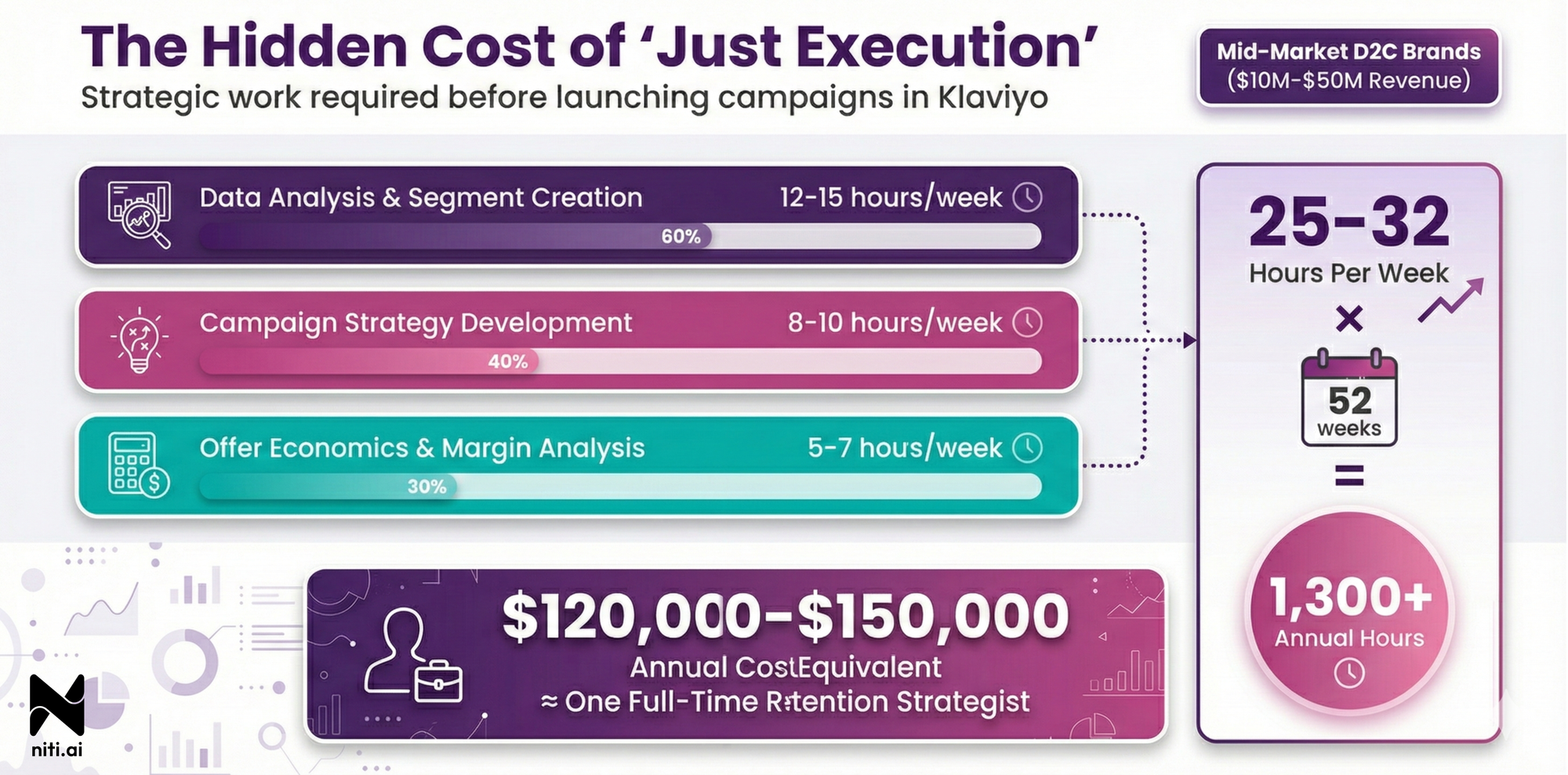
A typical mid-market D2C brand ($10M-50M revenue) using Klaviyo faces this reality:
- 12-15 hours per week on data analysis and segment creation
- 8-10 hours per week developing campaign strategies
- 5-7 hours per week calculating offer economics and margin impact
- Total: 25-32 hours per week of strategic work before a single campaign launches
That's 1,300+ hours annually—roughly the cost of a $120,000-150,000 retention strategist—just to make Klaviyo valuable.
The Category That Changes Everything: Agentic Growth Strategists
While Klaviyo charges you more as your list grows (their February 2025 pricing changes increased costs by up to 25% for existing customers), a new category has emerged that fundamentally reimagines the retention problem.
Agentic Growth Strategists are autonomous AI systems that don't just execute campaigns—they create them. For a full breakdown of how this new category is defined, benchmarked, and implemented, explore The Complete Guide to Agentic Growth Strategists.
Think of it this way:

Meet Niti AI: The First True Agentic Growth Strategist
Niti AI isn't "Klaviyo with AI features." It's an entirely different architecture designed to replace human strategic work, not assist it.
The Six-Agent System That Thinks Like Your Best Strategist
Niti AI orchestrates six specialized AI agents working together as a unified strategic intelligence:
1. Insights Agent – Continuously monitors 100+ customer features to identify high-impact opportunities
- "Cart abandonment up 18% in high-AOV segment"
- "October cohort showing 35% expected repeat rate, actual 22%"
- "High-margin product category has 40% untapped growth potential"
2. Strategy Agent – Creates MECE (Mutually Exclusive, Collectively Exhaustive) campaign bundles
- Not random campaign ideas—complete strategic frameworks
- Every segment covered, zero overlap, maximum efficiency
- 8-10 ready-to-execute campaigns generated weekly
3. Segmentation Agent – Builds precise audiences from 100+ features
- RFM analysis, product affinity, browsing behavior, margin profiles
- Generates SQL queries + human-readable definitions
- Predicts segment value and response probability
If you’re still using broad, demographic buckets, our essay on why ‘going small’ wins—The Power of Going Small: Why Micro-Segmentation Drives Big Growth—shows how precision segments outperform big buckets.”
4. Offers Agent – Designs margin-aware promotions
- Calculates exact discount levels that protect profitability
- High-value customers get early access, not discounts
- Price-sensitive segments get strategic offers only when necessary
5. Playbook Agent – Creates channel-specific execution plans
- Email + SMS + WhatsApp sequences with optimal timing
- Copy templates tailored to segment psychology
- Performance predictions for ROI forecasting
6. Performance Agent – Tracks results and learns continuously
- Compares predictions vs. actual performance
- Feeds insights back into strategy generation
- Improves recommendations over time
The Economics That Will Make Your CFO Smile
Let's talk numbers—the language CFOs understand best.
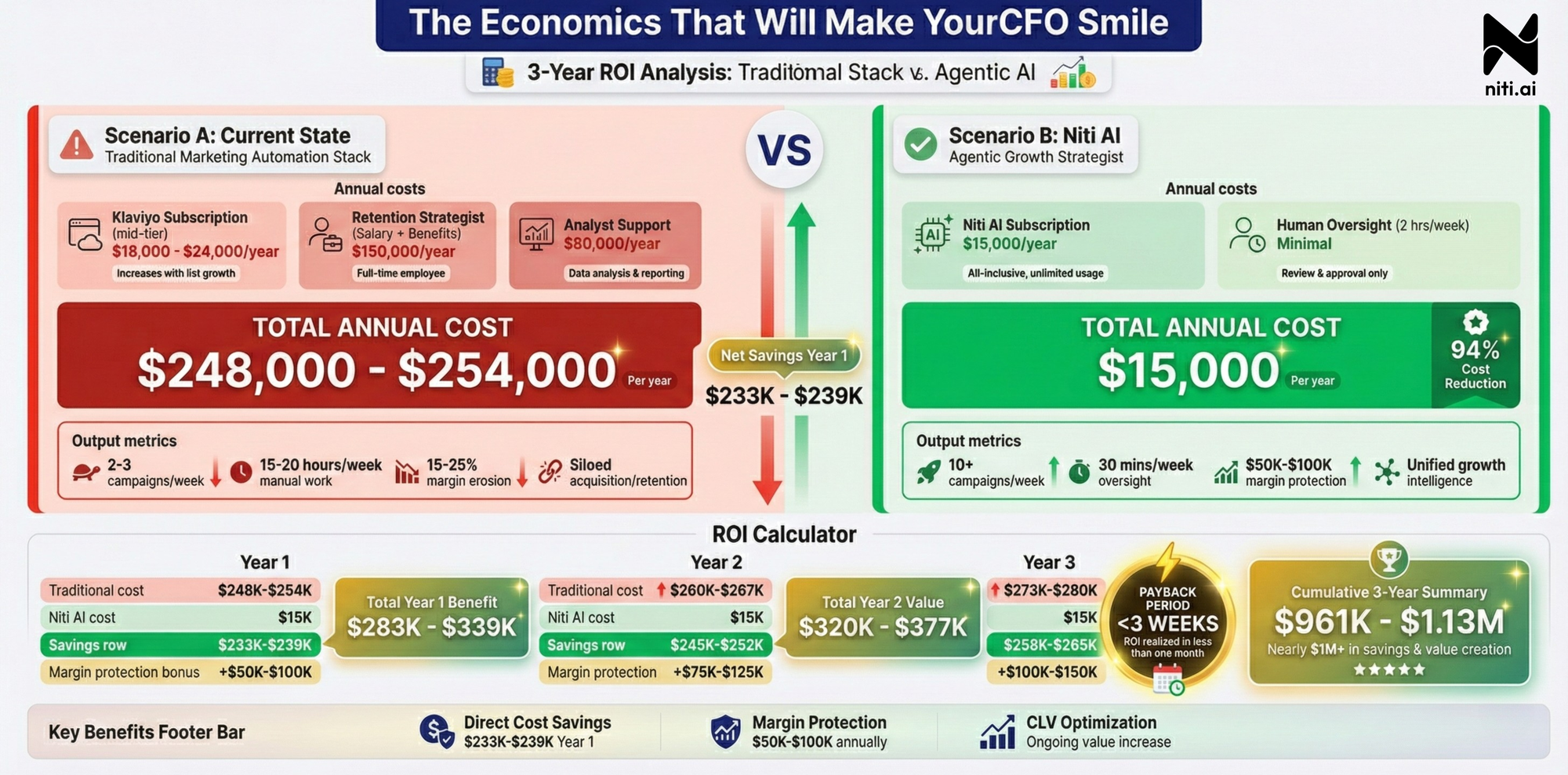
Scenario: Your Current State with Klaviyo
Annual Costs:
- Klaviyo subscription (mid-tier): $18,000-24,000/year
- Retention strategist salary + benefits: $150,000/year
- Analyst support: $80,000/year
- Total: $248,000-254,000 annually
Output:
- 2-3 campaigns per week
- 15-20 hours weekly on manual strategy work
- Generic discounting eroding 15-25% of margin
- No connection between acquisition and retention
Scenario: Moving to Niti AI
Annual Costs:
- Niti AI subscription: $15,000/year
- Human oversight (2 hours/week): Minimal
- Total: $15,000 annually
Output:
- 10+ campaigns per week
- 30 minutes weekly on review/approval
- Margin-aware optimization saving $50,000-100,000/year
- Full acquisition ↔ retention intelligence
Net Savings: $233,000-239,000 in Year 1 Payback Period: Less than 3 weeks
But here's what makes this truly compelling: Niti AI doesn't just save money—it makes you money by preventing margin erosion and optimizing customer lifetime value.
What Klaviyo's Latest Price Increases Really Mean
In February 2025, Klaviyo shifted from volume-based to "active profile" pricing—meaning even suppressed and unengaged contacts now count toward your bill. Existing customers saw increases capped at 25%, but new customers face the full pricing impact.
This change reveals something crucial: Klaviyo's business model is built on you having more customers, not you having better retention outcomes.
As your customer list grows, Klaviyo gets more expensive. The platform profits whether your retention improves or not.
Niti AI's model is different: flat annual pricing optimized for your profitability, not our billing growth.
Why Klaviyo Chooses Execution Over Strategy (And Why That Creates an Opening)
Understanding where platforms focus—and why—reveals market opportunities more clearly than feature comparisons ever could.
1. The Execution Platform Trade-off
Klaviyo's choice: Build the world's best multi-channel execution engine—email, SMS, push notifications, and customer data infrastructure at scale.
The consequence: When you optimize for 176,000+ customers executing billions of messages, you design for flexibility, not prescription. Klaviyo gives you powerful segmentation tools and lets you decide which segments matter this week. They provide the canvas; you provide the strategy.
Why this matters: For enterprise brands with dedicated strategy teams, this is exactly what they want—best-in-class execution without opinionated strategy getting in their way. But for mid-market brands ($2M-50M revenue) without $150K strategists on staff? The flexibility becomes a burden. You're paying for execution infrastructure while still doing 25+ hours of strategic work weekly.
Counter-positioning insight: Niti AI makes the opposite trade-off—we're opinionated about strategy. Our six-agent system analyzes your data and tells you exactly which segments to target, when, and why. This makes us perfect for brands who need strategy + execution, but less appealing to enterprises who already have strategy covered.
2. Engagement Metrics vs. Profit Metrics
Klaviyo's choice: Optimize for engagement—opens, clicks, conversions, and revenue. These are universal metrics that every marketing team understands and can act on.
The consequence: The platform excels at driving engagement but doesn't distinguish between profitable and unprofitable conversions. A 25% discount that converts a price-sensitive customer looks identical to a VIP offer that converts a high-value customer—both show successful conversions in the dashboard.
Why this matters: For brands in high-margin categories (software, luxury goods) where almost every conversion is profitable, engagement = profit. But for D2C brands operating on 40-60% margins? Blanket discount strategies can erode 15-25% of profitability even while "engagement metrics" improve. You're winning the wrong game.
Counter-positioning insight: Niti AI's Offers Agent calculates margin impact before recommending any discount. We tell you which customers can sustainably receive 20% off (because their LTV supports it) and which customers should get early access instead (because discounting them destroys unit economics). Klaviyo can't do this without you building custom analysis—it's not their core architecture.
3. Retention in a Silo vs. Full-Funnel Intelligence
Klaviyo's choice: Excel at retention marketing—post-purchase flows, win-back campaigns, loyalty programs. Let attribution platforms (Northbeam, Triple Whale) handle acquisition analytics.
The consequence: You can see that a customer churned, but not whether they were always going to churn based on their acquisition source. Klaviyo doesn't connect "this customer came from Meta ad campaign X" to "customers from campaign X have 40% higher churn rates."
Why this matters: If you're spending $50K-200K monthly on acquisition, knowing which channels bring retainable customers vs. churners is worth far more than optimizing send times. But getting this insight requires manually connecting attribution data to retention cohorts—work Klaviyo's architecture doesn't support natively.
Counter-positioning insight: Niti AI's data warehouse connects acquisition attribution (source, campaign, creative) directly to retention performance. The Performance Agent surfaces insights like "Meta lookalike audiences show 35% lower repeat rates than Google Shopping customers—recommend shifting 20% of budget." Klaviyo could theoretically add this, but it would require rebuilding their data architecture and potentially competing with their attribution platform partners.
4. Static Playbooks vs. Dynamic Strategy Generation
Klaviyo's choice: Provide 80+ pre-built automation flows (abandoned cart, post-purchase, win-back) that brands can customize and deploy.
The consequence: These are excellent starting points, but they're static templates. A "win-back flow" set up in January runs the same logic in June, even though your customer behavior, inventory, and margin structure have shifted. You need to manually review and update them quarterly—if you remember to do it.
Why this matters: For brands with stable product lines and predictable customer behavior, static flows work beautifully. But for brands with seasonal inventory, changing margin profiles, or rapidly evolving customer segments? Static playbooks become stale quickly. You need continuous strategy regeneration, not quarterly manual reviews.
Counter-positioning insight: Niti AI's Strategy Agent regenerates campaign recommendations weekly based on current data—new product launch, margin shift, cohort behavior change all automatically trigger updated strategies. This "continuous intelligence" model is fundamentally different from "deploy once, optimize manually" and would require Klaviyo to change how brands interact with their platform entirely.
The Monday Morning Difference
Traditional Klaviyo Workflow:
Monday 9am: CMO arrives, checks dashboards, sees cart abandonment trending up 9am-11am: Analyst pulls data from five sources, builds Excel models 11am-1pm: Team meeting to analyze patterns and debate approach Tuesday: Building segments manually in Klaviyo Wednesday: Designing offers, creating campaign briefs Thursday: Getting approval, making revisions Friday: Finally launching 2-3 campaigns
Total: 25+ hours, 2-3 campaigns
Niti AI Workflow:
Sunday 11pm: Insights Agent identifies cart abandonment spike in high-AOV segment Monday 6am: All six agents create 8 complete campaign strategies Monday 9am: CMO reviews AI-generated strategy bundle over coffee Monday 9:15am: Approves 6 of 8 campaigns with one click Monday 9:30am: Campaigns automatically pushed to execution channels Monday 10am: Campaigns live
Total: 30 minutes, 6-8 campaigns
This isn't incremental improvement. This is 10x productivity with better strategic outcomes.
Why Now? Why This Matters in 2025
Three forces converged to make Agentic Growth Strategists possible—and necessary:
1. AI Reasoning Models Matured Claude, GPT-4, and Gemini can now synthesize multiple variables and explain strategic decisions—not just predict outcomes.
2. Labor Economics Broke Finding and retaining experienced retention strategists ($150K+) has become nearly impossible for mid-market brands.
3. Speed Became Survival Markets move too fast for quarterly planning cycles. Brands need 10+ weekly campaigns to stay competitive.
Klaviyo was built in 2012 for a slower world where humans had time to think. Niti AI was built in 2025 for the world that actually exists.
The Question Isn't "Should I Replace Klaviyo?"
The real question is: "How long can I afford to pay for execution when I need strategy?"
If you're a $2M-50M revenue D2C brand currently using Klaviyo, you're likely:
✓ Spending $1,000-2,500/month on Klaviyo ✓ Spending 25+ hours weekly on strategic work Klaviyo can't do ✓ Watching 70% of LTV vanish to churn despite all your efforts ✓ Unable to hire the $150K strategist your competition has ✓ Eroding margins through blanket discount strategies
Niti AI solves all five problems for $15,000 annually—90% less than hiring while delivering 10x the strategic output.
The Integration Reality
"But we've spent years building our Klaviyo setup!"
Here's the good news: Niti AI doesn't replace Klaviyo's execution—it replaces the human strategic work before Klaviyo.
Niti AI integrates seamlessly with:
- Klaviyo (strategy → execution handoff)
- Shopify (customer data, product catalog, margin data)
- MoEngage, Braze (alternative execution platforms)
- WhatsApp, SMS platforms (multi-channel coordination)
You keep your execution infrastructure. You replace the 25+ hours of weekly human labor.
What Customers Say About the Transition
"We thought we needed a better Klaviyo analyst. What we actually needed was to stop doing Klaviyo analysis manually. Niti AI gave us back 20 hours a week while doubling our campaign output." — Head of Growth, $12M Fashion Brand
"Our CFO was skeptical until we showed the margin protection numbers. Niti's offer optimization saved us $73K in unnecessary discounting in Q4 alone. The ROI is ridiculous." — CMO, $28M Beauty Brand
"The acquisition ↔ retention bridge changed our entire marketing strategy. We finally know which ad channels bring customers who actually stick around." — VP Marketing, $35M Home Goods Brand. This bridge is part of a larger shift from reactive dashboards to AI-powered, margin-aware retention engines covered in our Ultimate Guide to AI-Powered Customer Retention in 2025.
The Category Is Emerging. The Leaders Are Being Chosen Now.
Marketing automation was the category of 2012-2024. Agentic Growth Strategists are the category of 2025-2035.
The early adopters who move now will have:
- 12-18 months of compound learning advantages
- Proof of margin improvements competitors can't match
- Strategic velocity competitors can't replicate
- Labour cost structures competitors can't sustain
The late adopters will be explaining to their boards why competitors achieved 3x their retention efficiency at 10% of their labour costs.
Your Next Step
Klaviyo will continue being an excellent execution platform. But if you're ready to stop paying $150K+ annually (in software + human labor) for strategic work that AI can do better, faster, and more profitably...
It's time to meet the Agentic Growth Strategist built for your growth.
→ Schedule a strategy demonstration → See the six-agent architecture in action → Calculate how good is your Retention
Niti AI: The autonomous growth strategist that replaces human strategic labour, not human strategic judgment.